
6 min read
Hyaluronic Acid: Effects on Skin, Joints and Forms of Intake
How hyaluronic acid works in the body, what role it plays for skin and joints and what research shows about taking it as a supplement.

Hyaluronic acid is known as an active ingredient in cosmetics, but it also appears as a dietary supplement in the joint and sports area. The reason lies in its special ability to bind large amounts of water, which makes it interesting both for the skin and for the tissue in the joints.
This guide explains what hyaluronic acid exactly is, where it occurs naturally in the body, what role it plays for skin and joints, in which forms it is offered and what research says about taking it as a dietary supplement.
01
What is hyaluronic acid?
Chemically, hyaluronic acid is a long-chain carbohydrate molecule, more precisely a glycosaminoglycan, made up of repeating sugar units. This structure gives it the ability to bind many times its own weight in water, which makes it a central building block of connective tissue.
The body produces hyaluronic acid itself and also breaks it down again; it occurs in the skin, the eye, the joint fluid and the cartilage tissue, among other places. With increasing age, the body's own production tends to decline, which is linked, among other things, to lower skin moisture and changes in the joints.

02
Hyaluronic acid in skin and connective tissue
In the skin, hyaluronic acid together with collagen and elastin provides moisture, elasticity and firmness. It holds water in the tissue and so contributes to a plump, smooth appearance of the skin. If the hyaluronic acid content declines over the years, this can show, among other things, as lower skin moisture. How strongly individual external or internal measures affect visible skin changes varies from person to person and cannot be predicted in general.
Externally, hyaluronic acid is often used in cosmetics in creams or serums, where it is meant to have a moisture-binding effect on the skin surface. As a dietary supplement, by contrast, it is taken orally, and absorption through the digestive tract works differently from external application on the skin.
03
Hyaluronic acid and joints
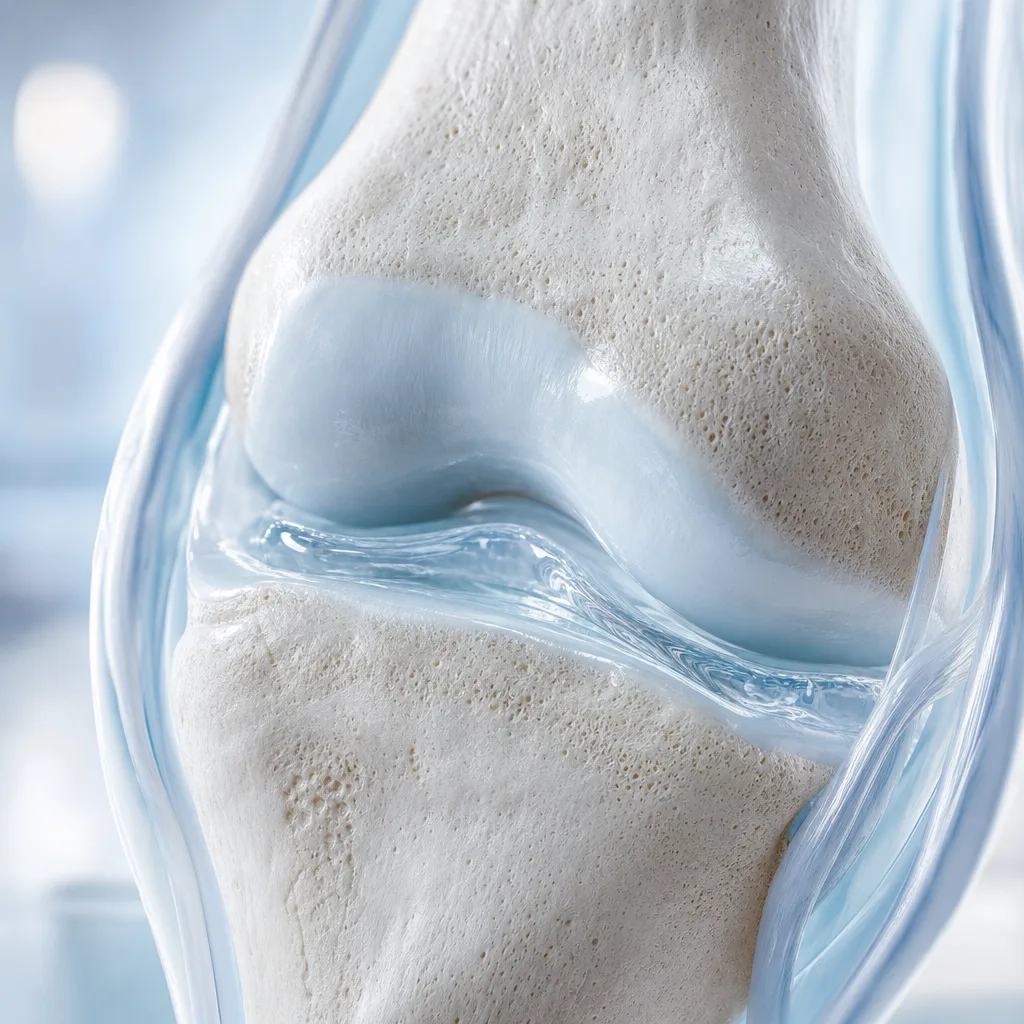
In the joints, hyaluronic acid is a central component of the joint fluid, which ensures smooth movement between the joint surfaces. There it acts something like a lubricant and contributes to shock absorption in the cartilage. Under heavy physical load, such as in strength or endurance sport, the joints are exposed to increased mechanical stress, which is why joint health often comes up among active people in particular.
In the medical field, hyaluronic acid is used, among other ways, as injections directly into affected joints, for example in certain wear-related conditions. This is a medical procedure and is clearly to be distinguished from oral intake as a dietary supplement, which follows a different mode of action and is not equivalent to medical treatment.
Another aspect that often comes up among athletic people is the interplay between joint load and training intensity. Anyone who increases the load too quickly, for example in a sudden switch from little movement to intensive running training, exposes the joints to unaccustomed strain. A gradual increase in training volume is regarded as a sensible approach to prevention, regardless of whether a supplement is taken in addition.
04
Forms and intake
As a dietary supplement, hyaluronic acid is mainly common in capsule form, less often as a powder or liquid. The following table gives an overview of common forms of use.
| Form | Typical area of use |
|---|---|
| Capsules, oral | dietary supplement for skin and joints |
| Injection | medical use, for example for joint complaints or in aesthetic medicine |
| Cream, serum | external cosmetic use on the skin |
| Eye drops | use for dry eyes, in consultation with medical professionals |
For oral capsules, the usual amount follows the manufacturer's instructions on the pack, since the concentration and the molecular weight of the hyaluronic acid used can differ between products. A blanket dosage recommendation therefore cannot responsibly be given; the pack information offers the most reliable guidance.
Besides intake, lifestyle also plays a role in the body's own hyaluronic acid production. Enough fluid, protecting the skin from excessive sun exposure and an overall balanced diet are often mentioned as supporting basic measures, even though the exact influence on the body's own hyaluronic acid content is hard to isolate and measure scientifically.
 Matching productWhey IsolateAmazon →
05
Interplay with other nutrients
In connective tissue, hyaluronic acid does not stand alone but works closely with other structural building blocks. Collagen provides the firm framework the tissue is organised around, while hyaluronic acid binds the water that provides elasticity and volume. Vitamin C also plays an indirect role, as it is needed for the body's own collagen formation; more on this in the section on vitamins and nutrients.
Some dietary supplements therefore deliberately combine hyaluronic acid with further nutrients for skin and connective tissue, for example collagen peptides. Whether such a combination actually brings an additional benefit over taking hyaluronic acid alone has not been conclusively settled scientifically and probably also depends on the individual starting point.
06
Who might consider hyaluronic acid as a supplement
People who regularly stress their joints through strength training, running or other demanding sports are often interested in hyaluronic acid as a complementary measure alongside training that is generally gentle on the joints. Hyaluronic acid is also often discussed in connection with skin appearance with age, although individual results vary greatly and cannot be predicted in general.
Anyone additionally interested in further nutrients around cartilage and connective tissue will find complementary context in the guides on glucosamine and chondroitin, which play a related but distinct role in the body for joint health.

07
What the research says
Scientific studies exist on oral intake of hyaluronic acid for skin and joints, but the evidence overall is mixed and the number of larger, independent studies is limited. Some studies report improved skin moisture or a more comfortable feeling of movement in the joints, while other studies show hardly any measurable differences. How strong an effect is individually depends on many factors, such as age, starting condition and duration of intake.
The role of hyaluronic acid in medically administered injections in certain areas of medical use is considerably better documented, but this cannot be transferred directly to the effect of an orally taken dietary supplement, as the two routes of use work differently. A dietary supplement with hyaluronic acid does not replace a balanced diet or medical treatment for existing joint complaints.
08
Frequently asked questions
How quickly does hyaluronic acid work as a dietary supplement?
Reliable time frames cannot be given in general, as individual reactions and study results vary greatly. Anyone considering taking it should assume a longer period rather than a quick effect.
Is hyaluronic acid as a dietary supplement suitable for everyone?
For most healthy adults, oral intake is regarded as harmless. In the case of existing conditions, during pregnancy or when taking medication, a conversation with medical professionals beforehand is recommended.
What is the difference between hyaluronic acid and collagen?
Collagen is a structural protein, whereas hyaluronic acid is a water-binding carbohydrate molecule. Both occur in connective tissue and are often mentioned together in connection with skin and joints, but they fulfil different functions in the body.
Can I get hyaluronic acid through food?
Hyaluronic acid occurs in small amounts in some animal foods, such as cartilage or bone broth. The amounts are, however, considerably lower and less standardised than with a targeted dietary supplement.
Does hyaluronic acid as a dietary supplement have side effects?
With oral intake at usual amounts, serious side effects are regarded as rare; mild digestive complaints are occasionally reported. If you are unsure or have existing conditions, consulting a doctor makes sense.
Does hyaluronic acid replace medical treatment for joint problems?
No, a dietary supplement with hyaluronic acid is not a treatment and does not replace a medical assessment of existing joint complaints. With persistent pain or restricted movement, going to medical professionals is the right first step.
Is a combination with collagen worthwhile?
Many products combine both substances because they work together in connective tissue. A clearly documented added benefit over taking either alone cannot, however, be derived from current research in every case.
How do I recognise the quality of a hyaluronic acid product?
A look at the ingredient list and the stated amount per serving tells you more than advertising claims on the pack. We deliberately do not give concrete purchase recommendations for individual brands or products.
Explore
Read next
 Protein types at a glance: whey, casein, plant-based and moreAn overview of all common protein types from whey to collagen, with a comparison table and links to detailed guides.
 Amino Acids: The Building Blocks of ProteinStructure, classification and functions of amino acids at a glance, with a table of all 20 proteinogenic amino acids and links to all guide…
 Supplements for Sport and Fitness: A Factual OverviewAll supplement categories at a glance, with the evidence rated from good to thin, plus safety and buying tips.