
6 min read
GABA: Effects in the Nervous System and Role in Sport
What GABA does in the body as a neurotransmitter, what role it plays in sport and what the evidence shows for supplementation.

GABA, spelled out gamma-aminobutyric acid, is a messenger substance produced by the body that has an inhibiting, that is calming, function in the nervous system. As a dietary supplement, GABA is discussed both in connection with relaxation and sleep and in the sports area.
This guide explains what GABA is in the body, how it differs from classic protein-building amino acids, what role it plays in the nervous system and in connection with training, and what research shows about taking it as a dietary supplement.
01
What is GABA?
GABA is the abbreviation for gamma-aminobutyric acid and belongs to the group of so-called non-proteinogenic amino acids. This means GABA is not built into proteins like the classic 20 amino acids, but takes on a different, distinct task in the body: that of a messenger in the nervous system, also called a neurotransmitter.
The body forms GABA itself, among other things from the amino acid glutamic acid. As a dietary supplement, GABA is mostly offered in capsule or powder form, although the question of how much of it is actually absorbed by the body and becomes effective has not yet been conclusively settled scientifically.
It is also important to note that GABA as a dietary supplement is not comparable with prescription medicines that act specifically on the same system in the nervous system. Such medicines are subject to stricter testing and are prescribed by doctors, whereas an over-the-counter GABA supplement follows a different legal framework and should be classified more cautiously accordingly.
 Matching productGlycineAmazon →

02
The function of GABA in the nervous system
As a neurotransmitter, GABA transmits signals between nerve cells and acts predominantly as an inhibitor, that is, it dampens the activity of the nervous system. Its counterpart is the messenger glutamate, which tends to be stimulating. This interplay of inhibiting and stimulating signals is important for the normal functioning of the nervous system and is not determined solely by supplying a single substance from outside.
In connection with GABA, topics such as relaxation, inner calm and sleep quality are often mentioned. An immediate medical effect should not be derived from this, however, since the corresponding dietary supplements are not medicines.
Another aspect is the large number of processes in which GABA is involved in the nervous system, for example in interplay with other messengers and receptors. This complexity explains why the effect of a substance supplied from outside cannot easily be predicted, even when the basic function of GABA in the body is well researched.
03
GABA in sport
In an athletic context, GABA is partly discussed in connection with recovery and sleep, since restful sleep plays an important role in adapting to training. A direct effect on muscle building or strength gain, on the other hand, is not documented scientifically; GABA is not a classic muscle-building amino acid like leucine or other amino acids from protein sources.
Some athletes therefore use GABA more in the evening or after particularly strenuous training days, on the assumption that better recovery indirectly benefits training too. Scientifically, this indirect connection cannot be confirmed in every individual case.
 Matching productL-GlutamineAmazon →
04
Forms and intake
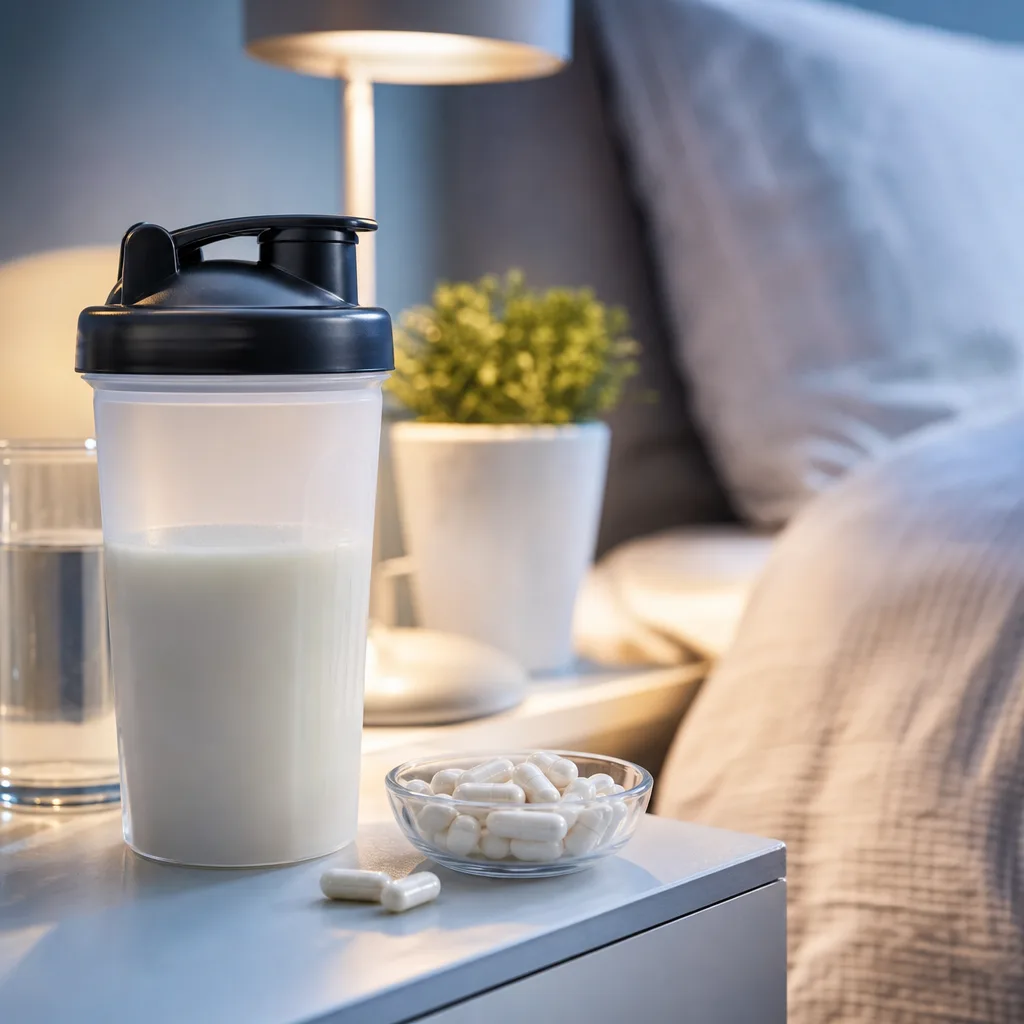
GABA is mostly offered as a capsule or powder, less often as a component of more complex dietary supplements. The following table shows a rough classification of common areas of use.
| Area of use | Usual classification |
|---|---|
| Evening intake | discussed in connection with relaxation |
| Before training | used less often, effect not clearly documented |
| In combination products | often combined with further calming ingredients |
A universally valid dosage recommendation cannot responsibly be given for GABA, as studies differ greatly in amount and duration of use. The pack information of the respective product serves as practical guidance, usually in the range of a few hundred milligrams up to a few grams per day.
Outside sport, too, GABA is occasionally mentioned in connection with coping with stressful everyday situations. Robust scientific evidence for an independent, clearly measurable effect on perceived stress is so far largely lacking, which is why corresponding statements should be classified with restraint. Basic measures such as enough exercise, a regular daily rhythm and enough sleep are regarded in research overall as considerably better studied than individual dietary supplements.
05
GABA compared with other calming nutrients
Besides GABA, there are other nutrients discussed in connection with relaxation and sleep, such as magnesium or certain amino acids. Magnesium is involved in numerous metabolic processes, including muscle and nerve function, and is regarded as comparatively well studied where a deficiency is proven. GABA differs from this conceptually, as it is not primarily a deficiency nutrient but a messenger substance produced by the body, whose effect after oral intake is less clearly documented scientifically.
Anyone generally interested in the role of amino acids in connection with the nervous system will find a broader overview in the section on amino acids. A combination of several calming nutrients does not replace basic measures for restful sleep, such as fixed sleep times and a low-stimulus environment in the evening.
Since GABA is often offered together with further ingredients in one product, it is worth checking the full ingredient list when buying. That makes it easier to judge which component is actually contained in which amount, rather than relying solely on the active ingredient name highlighted on the pack.
 Matching productL-TryptophanAmazon →
06
Tolerability and important notes
In most healthy adults, a usual intake amount is regarded as well tolerated; in studies, mild side effects such as tingling in the face or slightly altered breathing were occasionally described, without a clear connection to GABA being established in every case. People with liver or kidney disease and epilepsy should have taking GABA checked by a doctor beforehand, as an individual assessment is important here.
In pregnancy and while breastfeeding, and when taking medication that acts on the nervous system, medical advice before taking it also makes sense. Dietary supplements with GABA are no substitute for a balanced diet or for medical treatment of sleep problems or inner restlessness.
07
What the research says
A fundamental challenge in researching GABA as a dietary supplement is whether, and to what extent, orally taken GABA reaches the central nervous system in relevant amounts at all. Scientists assess this question differently, which is why blanket statements on effectiveness can be made only to a limited extent.
Individual studies report subjectively perceived relaxation or improved sleep quality after taking GABA, while other studies find hardly any measurable differences from a placebo. Overall, the evidence on GABA as a dietary supplement is rather thin and not yet solid enough to make clear, reliable recommendations.
08
Frequently asked questions
Is GABA a protein-building amino acid?
No, GABA belongs to the non-proteinogenic amino acids and is not built into muscle protein. Its function in the body lies in the nervous system as a messenger, not in building muscle tissue.
Does GABA help you fall asleep?
Some users report a more relaxing effect in the evening, but the scientific evidence is mixed and not clear. With persistent sleep problems, medical advice is the more sensible first step.
Does GABA build muscle?
No, a direct effect on muscle building or strength gain is not documented scientifically. For muscle building, protein-building amino acids from sufficient protein intake matter more.
Who should not take GABA?
Pregnant and breastfeeding women, and people with liver or kidney disease and epilepsy, should have taking it checked by a doctor beforehand. Caution is also needed with medication that affects the nervous system.
How does GABA differ from melatonin?
Both are occasionally mentioned in connection with sleep, but they are different substances with different functions in the body. GABA is an inhibitory neurotransmitter, melatonin a hormone that helps control the sleep-wake rhythm.
Can I get GABA through diet?
GABA occurs in small amounts in certain fermented foods, such as some soy products or fermented vegetables. The amounts are, however, considerably lower than with a targeted dietary supplement.
Does combining GABA and magnesium make sense?
Both are mentioned in connection with relaxation, but work through different mechanisms. A clearly proven additional benefit of the combination cannot be reliably derived from current research.
Does GABA make you tired the next day?
Reports on this vary individually and are not consistently documented scientifically. Anyone who reacts sensitively should first test personal tolerance with a lower amount.
 Matching productAll-in-One Muscle BuilderAmazon →
Explore
Read next
 Protein types at a glance: whey, casein, plant-based and moreAn overview of all common protein types from whey to collagen, with a comparison table and links to detailed guides.
 Amino Acids: The Building Blocks of ProteinStructure, classification and functions of amino acids at a glance, with a table of all 20 proteinogenic amino acids and links to all guide…
 Supplements for Sport and Fitness: A Factual OverviewAll supplement categories at a glance, with the evidence rated from good to thin, plus safety and buying tips.