
8 min read
Home Workout: Training Effectively at Home
How to train effectively at home with little or more equipment, which weekly structure makes sense and what matters for nutrition.

Not everyone has the time, the inclination or a gym nearby to train there regularly, and that is not necessary at all. With little space, some basic knowledge and the right equipment, you can build a very effective strength training routine at home that maintains and builds muscle and clearly improves general fitness.
On this page you will learn what you can realistically achieve with a home workout and where its limits lie, how to build up your equipment step by step, what a sensible weekly structure looks like and how nutrition and motivation work together. At the end you will find links to all the relevant guides on training at home.

01
What Works at Home and What Does Not
With your own body weight, a few dumbbells or resistance bands, a large part of classic strength training can be covered: squats, lunges, push-ups, row variations, shoulder presses and core training work at home at least as well as in the gym. The limits lie mainly with heavy compound lifts using very high weights, such as the classic barbell squat or deadlifts with large plates; for these you need either special equipment or, eventually, a trip to the gym. For the vast majority of goals, from maintaining muscle through fat loss to general fitness, a well-planned home workout is entirely sufficient, especially if you raise the intensity through tempo, added weight or shorter rests instead of always thinking only of more weight. Endurance and flexibility can also be trained excellently at home, whether through interval training, jumps or classic mobility exercises, which need neither machines nor much space.
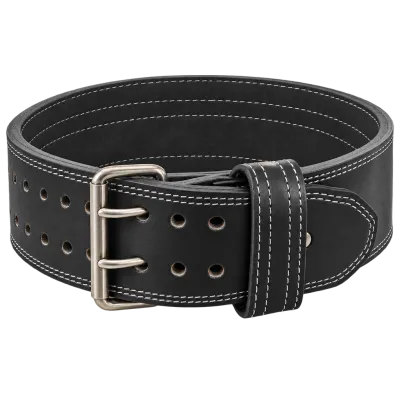 Matching productWeightlifting BeltAmazon →
02
Structure of a Typical Home Workout Session
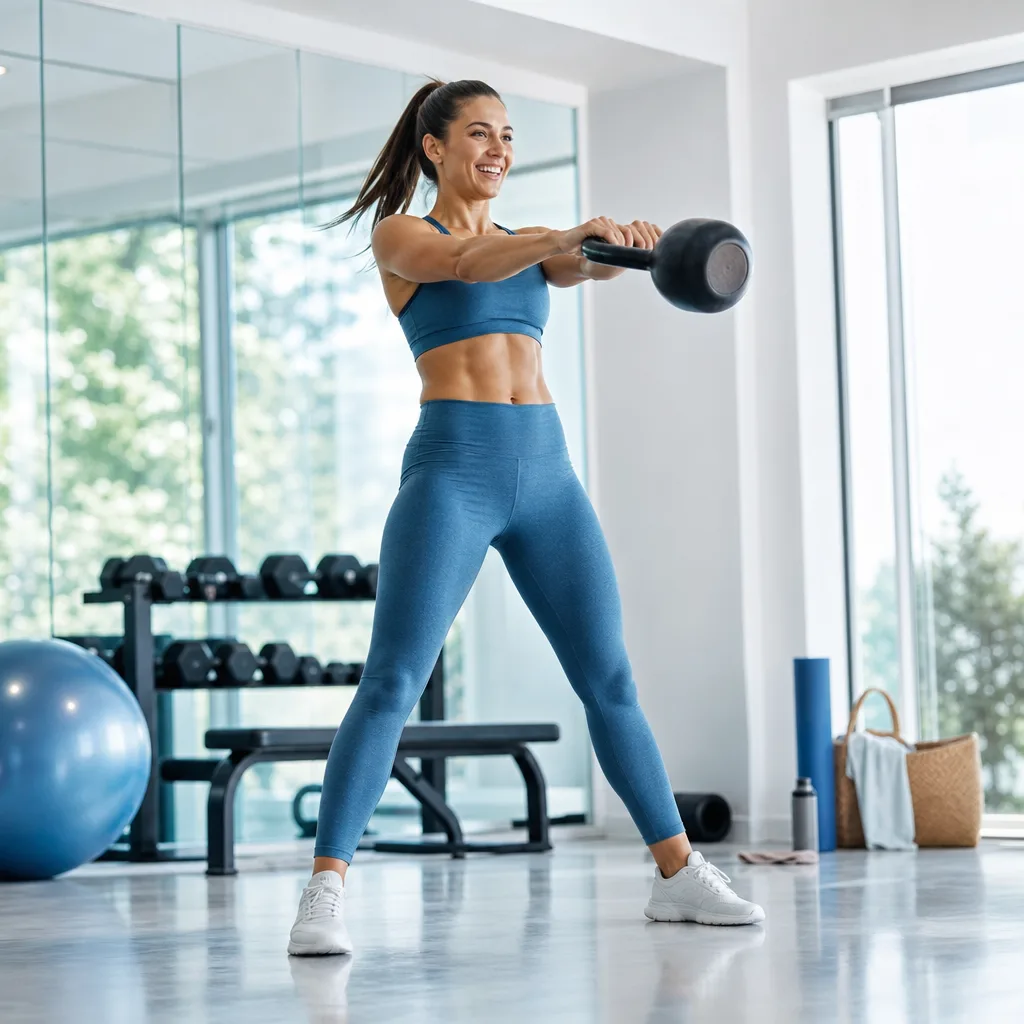
Even without a gym, a fixed structure for every session is worthwhile. It starts with a short warm-up of about five minutes, for example easy skipping, bodyweight squats or arm circles, to prepare circulation and joints for the load. Then comes the main part with four to six exercises that address as many different muscle groups as possible, for example one exercise for the legs, one for the back, one for the chest and shoulders and one for the core. Without extra weight you control intensity mainly through repetition count, tempo, rest length and exercise variations; with dumbbells, bands or a kettlebell you can also use the weight itself. Between sets, 45 to 90 seconds of rest are usually enough; for very demanding exercises such as squat jumps it can be somewhat longer. The finish is a short cool-down with calmer breathing and light stretching of the muscles worked. Depending on its scope, such a session takes about 20 to 45 minutes and fits well into a normal daily routine, with no travel time at all.
03
Equipment in Stages
You do not have to buy everything at once; you can expand your equipment step by step, depending on how regularly you train and which exercises you are still missing.
| Stage | Equipment | What it makes possible |
|---|---|---|
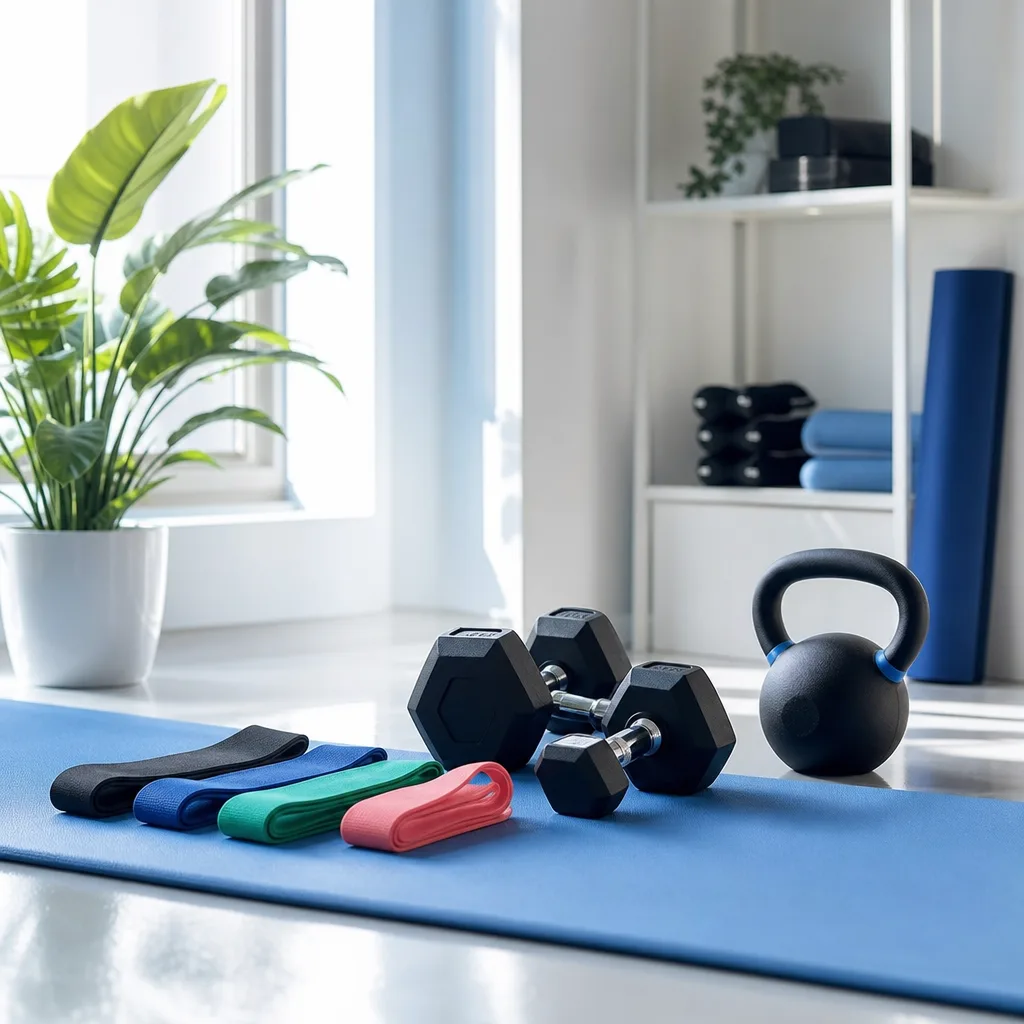
| 1 | No equipment, just body weight and a mat | Basic full-body training, see Home Workout Without Equipment |
| 2 | Resistance bands | More pulling variations and fine control of intensity, see Training with Resistance Bands |
| 3 | Dumbbells | Classic strength exercises with adjustable weight, see Home Workout with Dumbbells |
| 4 | Pull-up bar | Back training and pull-up variations, see Pull-Up Bar Training |
| 5 | Kettlebell | Dynamic full-body exercises with swing and muscular endurance, see Kettlebell Training |
If you want to train at home long term, it is best to plan a fixed corner for training. The guide Setting Up a Home Gym describes how to set up a small area sensibly and compactly, from floor protection to storage options. More important than the most complete setup possible is that you use the equipment you have regularly: a single pair of dumbbells that gets used every week does more for you than a full home gym that stands unused in the corner after a few weeks.
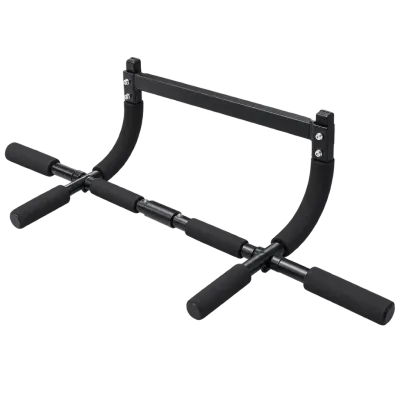 Matching productPull-Up BarAmazon →
04
Weekly Structure for Training at Home
To get started, two to three full-body sessions per week are perfectly sufficient, with at least one rest day in between. With growing experience and more available time, training can be differentiated further, for example into a day focused on legs and glutes, see Legs and Glutes at Home, a day focused on core and abs, see Ab Training at Home, and shorter, intense sessions in between. When time is short in particular, compact formats are practical: a 20-Minute Workout can almost always be fitted in, and intense intervals as part of HIIT at Home noticeably get your pulse and circulation going in a short time, in addition to pure strength training. It is important to adapt the weekly structure to your daily life rather than the other way round; a realistic plan with three fixed appointments is stuck to more reliably than an ambitious plan that is constantly postponed. Between training days, at least one complete rest day is worthwhile, on which at most light movement such as a walk takes place, so that stressed muscles and the nervous system can recover.
 Matching productL-TyrosineAmazon →

05
Motivation and Staying on Track
Training at home means that no fixed opening hours and no training partner automatically provide structure, but also that no commute and no waiting for machines makes getting started harder. Fixed training appointments in your calendar, a visible training corner that invites you to get going, and a simple log of exercises, weights and repetitions help you stay on the ball. Small, realistic milestones usually work better than vague resolutions, and a day off because of illness or heavy exhaustion is not a setback but part of sustainable training. Fixed rituals around training help too, such as always putting on the same sportswear or starting the same playlist, which gets your head into the coming session faster. If you regularly have to overcome your own inertia, you often benefit from making the first exercise particularly easy, because the hardest step is usually the beginning, not the session itself.
06
Nutrition to Go with It
For training at home, too, the rule applies: without suitable nutrition, part of the potential remains unused. For maintaining and building muscle, an adequate protein intake spread across the day is important; the guide Protein Requirement explains how to estimate your approximate needs. If fat loss is your priority, the guide Protein for Weight Loss also helps, showing how satiety and muscle maintenance can be combined well even in a calorie deficit. Dietary supplements can sensibly support an unbalanced diet, but they are not a substitute for enough vegetables, fruit, wholegrain products and enough fluid in everyday life. If you train at home and plan your meals yourself, you even have a practical advantage over a gym visit on the road: a protein-rich snack or shake can be prepared right after training in your own kitchen, with no detours and no cool bag.
07
What the Research Says
Comparative studies between training in a gym and training at home with simple equipment usually show comparable gains in strength and muscle when the training stimulus is similar, that is, similar effort, repetition count and progression over time. What matters, then, is less the place than the consistent application of the core principles from the area Training Plans: a sufficient stimulus, regular repetition and slow progression over weeks and months. With very high weights, as are usual in classic powerlifting, pure home workouts naturally reach their limits, but for general fitness, maintaining muscle and a large part of muscle building this is rarely the limiting factor. On the question of whether free bodyweight exercises or exercises with added weight are more effective, the evidence also shows no clear picture; in both cases what matters most is whether the stimulus is demanding enough and whether it is increased over time. If you have existing complaints or pre-existing conditions, are pregnant, or are returning after a longer break from training, the same applies here: have it checked medically beforehand and always put technique before weight or tempo.
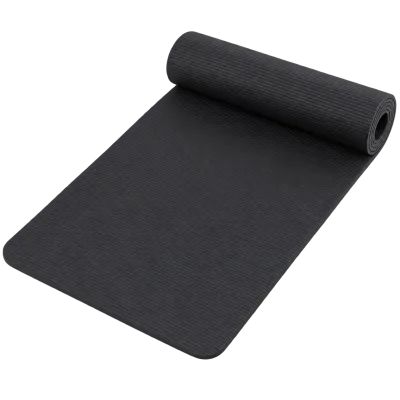 Matching productExercise MatAmazon →
08
Frequently Asked Questions
Will I build as much muscle at home as in the gym?
With a comparable training stimulus and consistent progression, the differences are usually small. With growing experience, however, it becomes harder to keep increasing the weight at home; additional equipment such as dumbbells, bands or a pull-up bar then helps.
How much space do I need at minimum?
For most exercises a free area of about two by two metres is enough, roughly the space of an unrolled training mat with a little room to move at the sides.
Is 20 minutes of training enough at all?
Yes, compact, intense sessions in particular can set an effective training stimulus when performed well. More important than pure duration is how consistently and regularly you carry them out.
What if I cannot motivate myself at home?
Fixed appointments, a fixed training corner and a short, clearly planned programme lower the barrier to getting started considerably. Some people also find it helpful to arrange with another person to train together at fixed times, even if each of you trains at home on your own.
When is it worth switching to a gym?
As soon as the equipment available at home is no longer enough for further progress, for example because your dumbbells are no longer heavy enough, or if you miss the social environment and larger machines, a gym can be a sensible addition.
Can I combine home workouts and gym training?
Yes, that is in fact a popular solution: on days when there is no time to get to the gym, a short home workout provides the basics, while on other days heavier compound lifts or larger machines take centre stage at the gym. All that matters is that load and recovery fit together over the week as a whole.
09
All Guides to Training at Home
- Home Workout Without Equipment, a complete full-body workout using only your own body weight.
- Home Workout with Dumbbells, classic strength exercises for home with adjustable weight.
- Training with Resistance Bands, a space-saving alternative with fine control of intensity.
- 20-Minute Workout, a compact programme for days with little time.
- Ab Training at Home, targeted exercises for the core muscles.
- Legs and Glutes at Home, effective leg training without a gym.
- HIIT at Home, intense intervals for fitness and calorie burn.
- Pull-Up Bar Training, back training with a simple, space-saving purchase.
- Kettlebell Training, dynamic exercises for strength and muscular endurance at once.
- Setting Up a Home Gym, how to set up a small, permanent training corner.
- Training Plans, the core principles behind every good training plan.
- Protein Requirement, how to roughly estimate your personal daily needs.
- Protein for Weight Loss, how protein supports satiety and muscle maintenance in a deficit.
Explore
Read next
 Protein types at a glance: whey, casein, plant-based and moreAn overview of all common protein types from whey to collagen, with a comparison table and links to detailed guides.
 Amino Acids: The Building Blocks of ProteinStructure, classification and functions of amino acids at a glance, with a table of all 20 proteinogenic amino acids and links to all guide…
 Supplements for Sport and Fitness: A Factual OverviewAll supplement categories at a glance, with the evidence rated from good to thin, plus safety and buying tips.