
7 min read
Protein requirement: how much protein you need per day
How much protein you need per day depends on age, weight and goal. With a calculator, reference values, a table by body weight and the limits of these values.

How much protein you need per day depends on several factors: age, body weight, physical activity and special life stages such as pregnancy. There is no single figure that applies equally to everyone, but there are reference values you can use as a guide.
This article explains the reference values of the German Nutrition Society (DGE), puts the higher values often cited in sports science into context and uses a table to show how requirement changes with body weight. At the end we also look at the limits of these guideline values.
Calculate your protein needs
Your guideline
per day
per meal with 4 meals
Reference values: about 0.8 g per kg (about 1.0 g from age 65), sports science 1.2 to 2.0 g per kg for strength training and diets. Not medical advice.
01
DGE reference values
For healthy adults, the DGE gives a guideline of about 0.8 grams of protein per kilogram of body weight per day. This value is regarded as a reference for adequate supply at average activity and is deliberately set conservatively, so that it offers a solid guide for most healthy people without particular athletic demands.
It is no substitute for individual advice but serves as a general starting point. If you eat considerably more or considerably less than usual, you should treat this value as a rough framework rather than an exact target that must be hit every day. The value of about 0.8 grams per kilogram of body weight was chosen so that it ensures adequate supply for the vast majority of healthy adults, even on days with somewhat lower intake, since the body has certain reserves.
02
Protein requirement by age
Protein requirement changes with increasing age. From about 65 years, the DGE gives a guideline of about 1.0 gram of protein per kilogram of body weight per day, because muscle protein synthesis works less efficiently in older age and a somewhat higher amount can help maintain muscle mass.
Age-specific values that follow growth also apply in childhood and adolescence. In case of doubt, individual advice is worthwhile here, for example from a paediatrician, as requirement in this life stage is particularly closely linked to growth and development. You will find more on suitable sources for different life stages in our overview of protein types. Between young adulthood and the start of older age, the DGE reference value of about 0.8 grams per kilogram of body weight remains the usual guide, as long as there are no particular health circumstances or a considerably raised activity level that suggest a different assessment.

03
Protein requirement in sport
In sports science, higher values are often discussed for strength training and other forms of intensive training, usually in a range of about 1.2 to 2.0 grams of protein per kilogram of body weight per day. This range is not a fixed recommendation of this site but reflects what is often cited in the specialist literature, and it depends heavily on training volume, training goal and individual starting point.
If you train regularly and intensively, you can use this range as a guide, but there is no blanket figure for everyone who does sport. Recreational athletes with moderate training are often nearer the lower end of this range, while very intensive training is discussed nearer the upper end. Besides strength training, similar considerations are also discussed for sports with a high training load, for example team sports, where both strength and endurance components play a role. The type of training also matters: in the specialist literature, strength training aimed at building muscle is often linked with a somewhat higher protein intake than pure endurance training, although here too there is no fixed limit that applies equally to everyone who trains.
04
Protein requirement when dieting
Even during a diet with reduced calorie intake, a somewhat higher protein share is often discussed in sports science, frequently in the same range of about 1.2 to 2.0 grams per kilogram of body weight, because sufficient protein intake can help to preserve muscle mass even in a calorie deficit.
How protein fits into a diet also depends on the overall diet, the calorie balance and individual goals, and no general diet promises can be derived from it. A balanced composition of the whole diet remains more important than a single figure. Anyone planning a diet should also bear in mind that a permanently very large calorie deficit can be a burden on the body regardless of protein intake, which is why a moderate, well thought-out approach is usually more sensible in the long term than a very rapid change.
05
Protein requirement in pregnancy
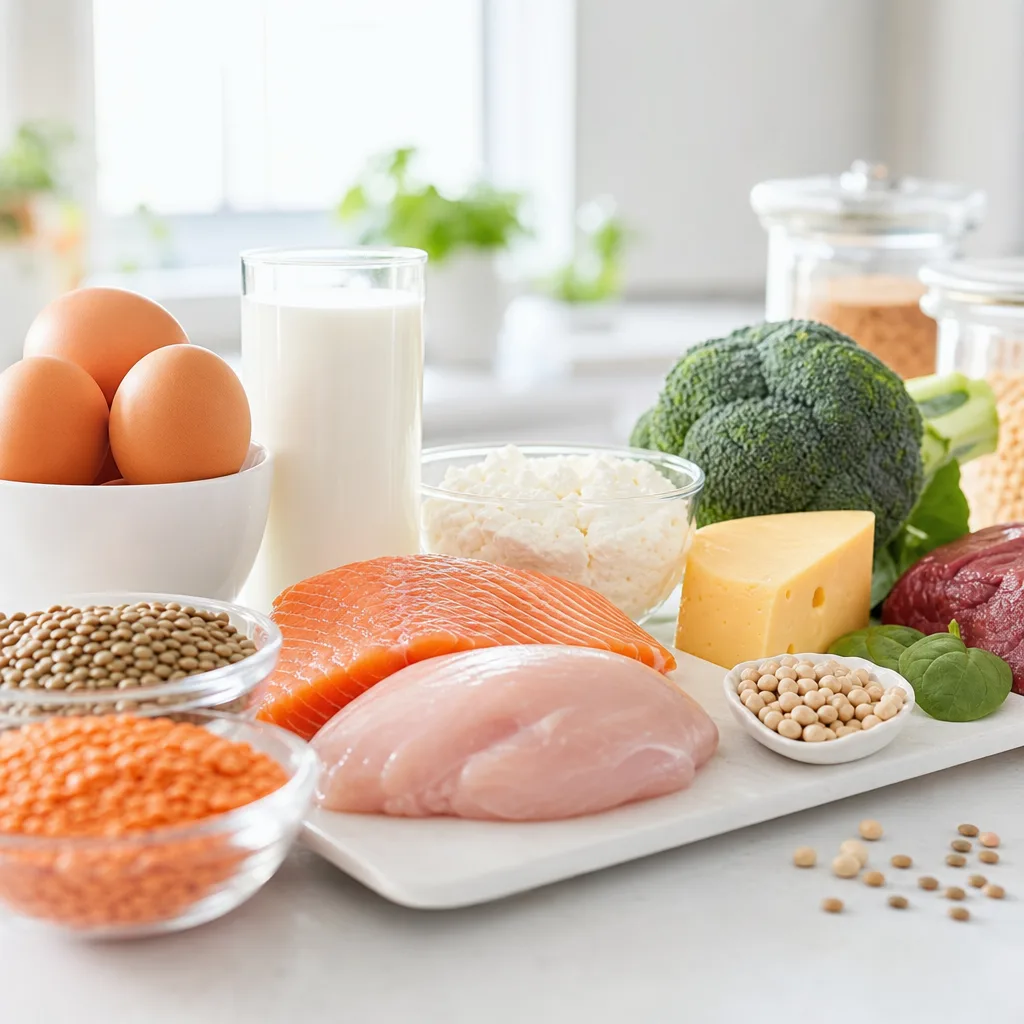
In pregnancy, nutrient requirement changes overall, and that includes protein. Since individual factors play a particularly large role here, you should not plan your protein requirement during pregnancy on the basis of general guideline values alone, but discuss it with your doctor or a midwife who knows your individual situation. This also applies during breastfeeding, as nutrient requirement here too can differ from that of someone who is not pregnant or breastfeeding, and an individual assessment matters more than a general reference value.
06
Body weight and gram range
| Body weight | About 0.8 g per kg (DGE) | Sports science range, about 1.2 to 2.0 g per kg |
|---|---|---|
| 50 kg | about 40 g | about 60 to 100 g |
| 60 kg | about 48 g | about 72 to 120 g |
| 70 kg | about 56 g | about 84 to 140 g |
| 80 kg | about 64 g | about 96 to 160 g |
| 90 kg | about 72 g | about 108 to 180 g |
This table offers a rough guide and does not replace an individual calculation. If you want to assess your personal requirement more precisely, you can also use the article calculating protein requirement. Intermediate values are easy to interpolate: at 65 kilograms of body weight, for example, the DGE reference value is about 52 grams and the sports science range about 78 to 130 grams per day.
07
Distribution across the day
Rather than taking the whole daily amount in a single meal, it is often considered sensible in sports nutrition to spread protein over several meals, so that the body has amino acids available regularly throughout the day.
A distribution across three to four protein-containing meals is often mentioned in this context, but there is no single scientifically exact ideal distribution, and individual daily routines and preferences also play a role. In practice this means, for example, planning eggs or low-fat quark for breakfast, a portion of legumes, meat, fish or tofu at lunch, and another protein-containing component in the evening, instead of taking the whole amount only in the evening. More on this in the article protein timing.
08
Limits and a note on the kidneys
The values given are guideline values for healthy people and not an individual recommendation. Actual requirement depends on many factors, including muscle mass, activity level, health status and other individual circumstances. Two people of the same body weight can therefore have different actual requirements, even though the simple calculation with body weight and reference value is certainly helpful as a first guide.
People with kidney disease should not increase their protein intake without medical advice, as the kidneys play a central role in breaking down the by-products of protein metabolism and a high intake can put additional strain on them when kidney disease is present. For other existing conditions or when taking medication, too, it makes sense to have a significant change in protein intake checked by a doctor beforehand. This applies especially if you plan to change your intake considerably over a longer period, for example through regular use of protein powder or a major change to your usual diet. You will find more on this topic, including common misunderstandings, in the article protein and kidneys: myths at a glance. Anyone who already takes medication or suffers from another chronic condition should also discuss a marked increase in protein intake beforehand rather than relying solely on general guideline values from the internet.
09
Frequently asked questions
Is more protein automatically better
No, more protein does not automatically lead to a better result. Above a certain requirement, additional protein usually brings no additional benefit, and a balanced overall diet remains decisive.
How do I calculate my personal protein requirement
As a starting point you can multiply your reference value by your body weight, based on the DGE figure of about 0.8 grams per kilogram or on the sports science range, depending on your activity level. If you are very active in sport or are planning a diet, you can also use the upper end of the stated range as a guide, but should assess your own starting point realistically. You will find detailed instructions in the article calculating protein requirement.
Does the DGE value also apply to athletes
The DGE value of about 0.8 grams per kilogram is aimed at healthy adults with average activity. For intensive training, higher values are often discussed in sports science, as described in the section on protein requirement in sport.
Can too much protein be harmful
For healthy people, a protein intake adjusted to activity and body weight within the ranges given is generally considered safe. People with kidney disease or other relevant pre-existing conditions should, however, have a higher intake checked by a doctor beforehand.
Explore
Read next
 Protein types at a glance: whey, casein, plant-based and moreAn overview of all common protein types from whey to collagen, with a comparison table and links to detailed guides.
 Amino Acids: The Building Blocks of ProteinStructure, classification and functions of amino acids at a glance, with a table of all 20 proteinogenic amino acids and links to all guide…
 Supplements for Sport and Fitness: A Factual OverviewAll supplement categories at a glance, with the evidence rated from good to thin, plus safety and buying tips.