
6 min read
Home Workout Without Equipment: A Training Plan for Home
A complete full-body plan with bodyweight exercises that you can do at home without any equipment.
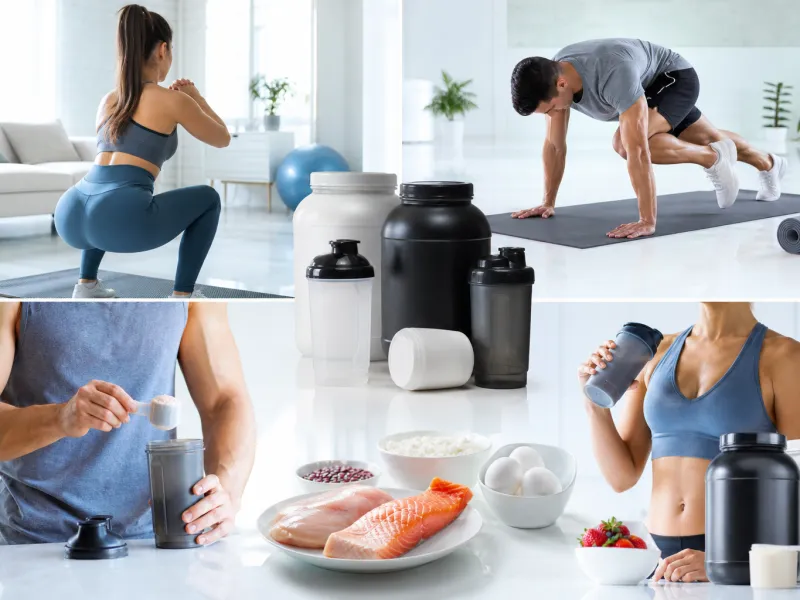
Effective strength training needs neither a gym nor expensive equipment. With your own body weight you can work all the major muscle groups, from the legs and core to the chest, back and arms. That makes a home workout without equipment especially practical for anyone with little space, little time or no access to a gym.
This guide gives you a complete training plan for home, explains the most important exercises and gives you an overview of equipment, nutrition and the current evidence on training with your own body weight.
01
Why bodyweight training works
Muscles respond to mechanical load, regardless of whether it comes from a dumbbell or from your own body weight. Exercises such as squats, push-ups or lunges can be adjusted through tempo, extra repetitions, rest length and single-leg or single-arm variations so that they remain challenging even for trained people.
For getting started and for the first months of strength training, your own body weight is usually entirely sufficient to achieve noticeable progress in strength and muscle. If you are already more advanced, you can keep progressing with harder variations such as single-leg squats or push-ups with your feet raised, or add dumbbells or resistance bands to your training.
Another advantage is the low risk of injury compared with exercises using free weights. Because your own body weight as resistance hardly ever leads to sudden overload, this form of training is particularly suitable for people who are new to strength training, have taken a long break or want to work on their movement quality before training with added weight.
 Matching productSuspension TrainerAmazon →
02
The training plan
The following full-body plan suits two to three sessions per week with at least one rest day in between. Do the exercises in order and focus on clean technique before you increase repetitions or sets.
| Exercise | Sets | Repetitions | Rest |
|---|---|---|---|
| Squats (bodyweight squat) | 3 | 12-15 | 60 sec. |
| Push-ups (on your knees if needed) | 3 | 8-12 | 60 sec. |
| Alternating lunges | 3 | 10-12 per side | 60 sec. |
| Superman (lower back) | 3 | 12-15 | 45 sec. |
| Forearm support (plank) | 3 | 30-45 sec. | 45 sec. |
| Glute bridge | 3 | 15-20 | 45 sec. |
Warm up for a few minutes before the session and mobilise the most important joints. You will find more on this in the guide Warming up and mobility. Progress your training following the principles of progressive overload, for example through more repetitions, shorter rests or more demanding variations.
 Matching productWeightlifting BeltAmazon →
03
What you need
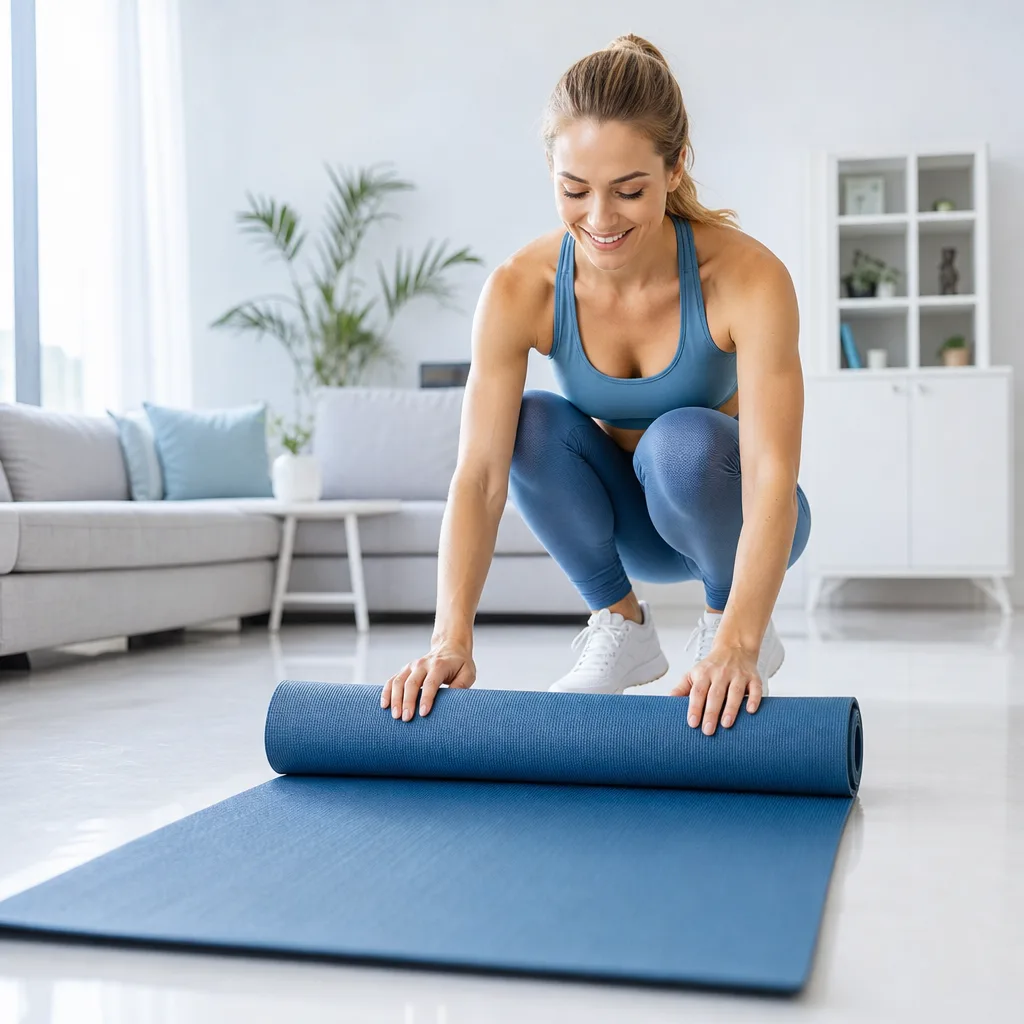
The big advantage of a home workout without equipment is that you need hardly any gear. A non-slip training mat protects your knees and elbows during floor exercises and gives you a secure footing. Comfortable, breathable sportswear and sturdy training shoes with good grip help you perform squats and lunges in a controlled way. A water bottle within reach reminds you to drink enough during training as well.
Anyone who trains regularly at home often also benefits from a small towel and some free space of around two by two metres; no more equipment is needed for this programme. A small mirror or a wall with enough distance can also help you check your own technique in squats and lunges, as long as no trained training partner is available.
 Matching productWater BottleAmazon →
04
Technique and common mistakes
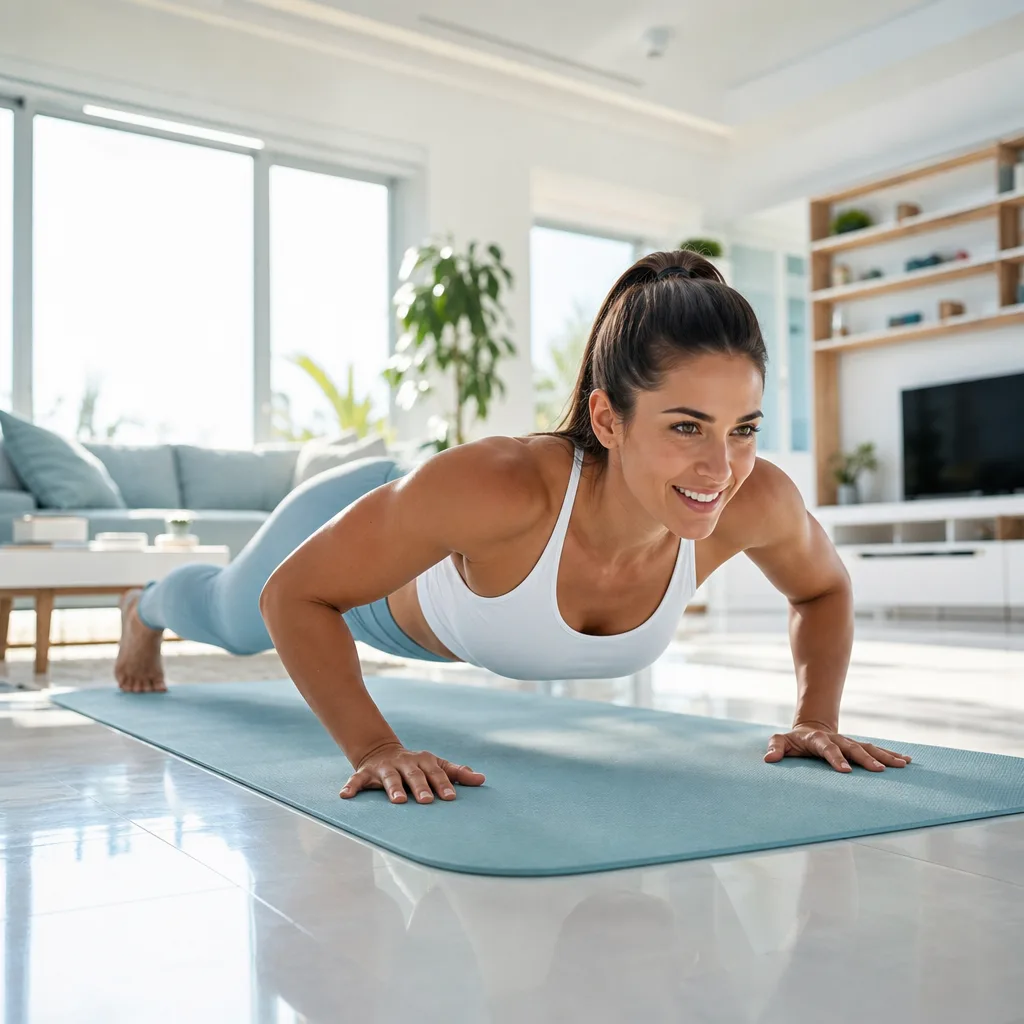
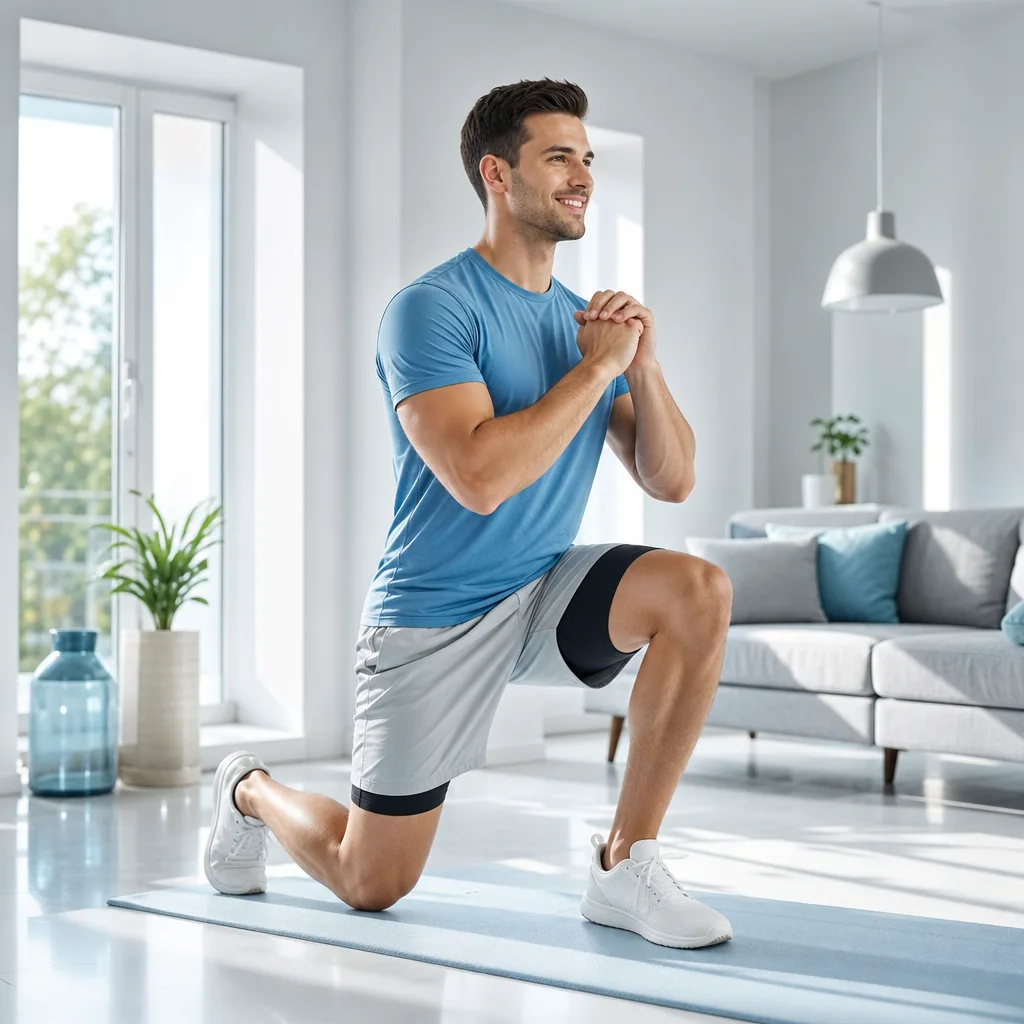
In the squat, your knees should point in the direction of your toes and not cave inwards, and your weight stays over the whole sole of the foot. In the push-up, the body forms a straight line from head to heel; a sagging pelvis puts unnecessary strain on the lower back. In lunges, an upright torso helps to protect the knee and keep your balance.
Breathing also plays a role: in most exercises you breathe out during the more strenuous phase, for example when pushing up out of the squat or during the push-up, and breathe in again during the easier phase. Conscious, even breathing helps you control the movement more steadily, rather than holding your breath during the effort.
A common mistake is wanting too many repetitions too quickly before the technique is solid. It is better to perform the movements slowly and in a controlled way before increasing tempo or volume. If you have pain, pre-existing conditions, are pregnant or have had a longer break from training, you should seek medical advice beforehand and increase the load slowly.
 Matching productDip BarsAmazon →
05
Variations for more variety
Once the basic plan feels easy, you can increase the intensity in several ways. Single-leg squats or push-ups with your feet raised challenge the muscles more. Isometric holds, such as an extended plank or a held squat, improve muscular endurance. If you also want to challenge your heart rate, you can do the sets in circuit format one after another without long rests, similar to HIIT training. A short 20-minute workout is also suitable for a compact, time-saving format.
The tempo of the movement can also be used as an adjustable variable: a slow, controlled lowering phase of three to four seconds in the squat or push-up increases the time under tension and therefore the training stimulus, without any additional weight being needed. If you also want to work your leg muscles or your core in particular, you can add suitable exercises to the programme accordingly.
06
Nutrition to go with it
Alongside the training stimulus, muscle also needs enough protein and an overall balanced diet in order to build or maintain itself. How much protein makes sense for you depends on body weight, training goal and activity level; you will find an assessment in the guide Protein requirement. If muscle building is the priority, it is also worth a look at the guide Protein for muscle building. Dietary supplements can usefully complement a balanced diet, but they do not replace it.
Besides the amount of protein, its distribution over the day also plays a role: several smaller, protein-rich meals tend to support muscle building better than a single large portion in the evening. Anyone who eats a balanced meal with protein and carbohydrates straight after training supports both recovery and the resupply of energy to the muscles.
 Matching productAll-in-One Muscle BuilderAmazon →
07
What the research says
Sports science has shown for years that strength training with your own body weight, at sufficient intensity, can achieve effects on muscle strength and muscle mass similar to classic machine training, as long as the load is increased over time. What matters here is less the equipment than that the muscles are brought close to their current limit. For very advanced athletes, however, it eventually becomes harder to keep increasing the stimulus with body weight alone; here studies show an advantage for additional external resistance such as dumbbells or bands. For getting started and for maintaining strength in daily life, bodyweight training is considered a well-supported and safe option.
There are also indications on frequency: studies on training volume suggest that training a muscle group two to three times per week gives somewhat better results on average than training only once a week, provided the total load remains comparable. More important than the exact frequency, though, is that training takes place regularly at all and with sufficient effort.
08
Frequently asked questions
How often should I train without equipment?
Two to three sessions per week with rest days in between are generally enough for visible progress. On rest days the muscles adapt to the previous training stimulus, which is why constant training without recovery can be counterproductive. You can read more about why rest is important in the guide Recovery and sleep.
Do I really build muscle without weights?
Yes, as long as the load is high enough and is increased over time, for example through more repetitions or more demanding exercise variations.
What do I do if an exercise gets too easy?
Choose a harder variation, for example single-leg or with your feet raised, or add dumbbells or resistance bands to your training.
Is the plan also suitable for beginners?
Yes, the exercises can be adapted to your individual fitness level with fewer repetitions or simplified variations, such as push-ups on your knees.
How long does it take until I notice progress?
First improvements in strength and movement feel often appear after just a few weeks of regular training, whereas visible changes in the muscles usually take several months. Fixed timeframes are not very meaningful, as the course varies from person to person.
Do I have to complete the full round before every session?
No. On days with little time or energy it makes more sense to do a shorter version of the plan with fewer sets than to skip the training completely.
 Matching productL-GlutamineAmazon →
Explore
Read next
 Protein types at a glance: whey, casein, plant-based and moreAn overview of all common protein types from whey to collagen, with a comparison table and links to detailed guides.
 Amino Acids: The Building Blocks of ProteinStructure, classification and functions of amino acids at a glance, with a table of all 20 proteinogenic amino acids and links to all guide…
 Supplements for Sport and Fitness: A Factual OverviewAll supplement categories at a glance, with the evidence rated from good to thin, plus safety and buying tips.