
6 min read
Collagen Guide: What Collagen Protein Really Is
Collagen explained soberly: origin, incomplete amino acid profile, typical use and limits as a food supplement.

In recent years collagen has become a much-discussed term in the nutrition world, whether as a powder, a capsule or an additive in drinks. This guide explains soberly what collagen is, why it is unusual from the point of view of protein quality and what it is typically used for.
Important to note first: this site makes no promises of cure and no individual recommendations. Possible effects on skin or joints are deliberately worded with restraint, since the evidence overall is inconsistent.
01
What Is Collagen
Collagen is the name for a group of structural proteins found in the body in, among other places, skin, tendons, ligaments, cartilage and bone. It is one of the most abundant proteins in the human body. Collagen products for nutrition mostly come from animal sources such as beef, pork or fish and are turned into a readily soluble powder form by hydrolysis, that is, breaking it down into smaller fragments, often called collagen hydrolysate or collagen peptides.
In nature, collagen forms long, fibre-like structures that give tissue stability and elasticity. With increasing age, the body's own collagen formation changes, a process regarded as a natural part of ageing that varies from person to person. This change is one reason why collagen is receiving increasing attention in the nutrition world, even though the transfer of ingested collagen to specific effects in the body has not yet been conclusively clarified scientifically.
 Matching productWhey HydrolysateAmazon →
02
Incomplete Amino Acid Profile
From the point of view of protein quality, collagen has a peculiarity: it contains little to no tryptophan, an essential amino acid, and overall a different amino acid pattern from many other animal proteins such as whey or egg. Instead, collagen is rich in glycine, proline and hydroxyproline, amino acids that play a structural role in connective tissue. Because an essential amino acid is missing or present only in small amounts, collagen is regarded as an incomplete protein and is not recommended in nutrition science as the sole protein source for general protein supply.
That does not mean collagen is useless, only that it cannot replace other protein sources such as meat, fish, dairy products, eggs or plant-based combinations of grains and legumes.
By comparison, complete protein sources such as eggs, dairy products or meat contain all nine essential amino acids in a proportion favourable to human needs. Collagen departs clearly from this, which is why nutrition science tends to view it as a specialised protein with a particular amino acid emphasis rather than as an equivalent replacement for daily protein supply.
 Matching productEAA PowderAmazon →
03
Typical Use of Collagen Products
Collagen powder is usually dissolved in water, juice or warm drinks and, thanks to its good solubility, is often described as neutral in taste. Some people take it in addition to their other protein intake, on the assumption that it might support skin, hair, nails or joints. What is mainly studied scientifically is whether regular intake of collagen peptides can stimulate the body's own collagen production in certain tissues. The available evidence on this is inconsistent overall, partly promising, partly burdened by methodological limitations, so no conclusive statement is possible here.
Besides taking it as a powder, collagen is also found in capsules or as an additive in drinks and individual foods. The form of delivery mainly affects how practical it is to use, for example whether a product is easy to take on the go, while the amount of collagen peptides contained can vary greatly from product to product. If you are interested in a product, you should compare the amount of collagen peptides per serving stated on the packaging with other information, rather than relying on advertised promises of effect alone.
In practice, collagen powder is usually taken regularly over a longer period, as any effects on tissue, if at all, would not be expected in the short term. Here too, no established, generally valid duration can be derived from the current evidence, which is why individual expectations should deliberately stay modest.
 Matching productProtein DrinkAmazon →
04
Collagen from Food Compared with Supplements
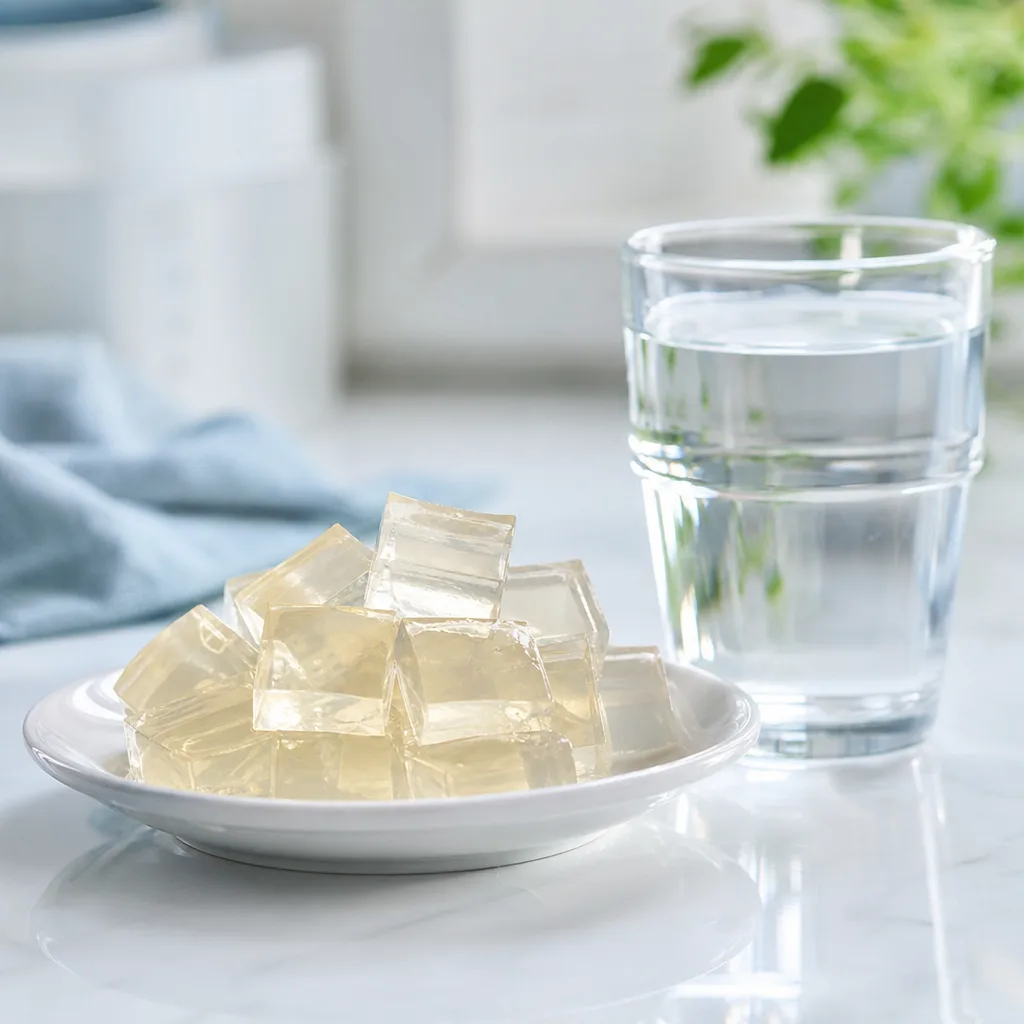
Collagen also occurs naturally in certain foods, such as bone broth, the skin and connective tissue of meat, or gelatine, which is made from collagen. These foods provide amino acids similar to collagen powder, but usually in smaller and less precisely measurable amounts. For people who want to take in a specific amount of collagen peptides, supplements are therefore more practical, while bone broth or gelatine are more of an additional, traditional source, from which no exact dosage can be derived.
 Matching productProtein Bread Baking MixAmazon →
05
Limits of Collagen Supplements
A realistic view of the limits of collagen as a food supplement is important. After ingestion, collagen peptides are broken down in the digestive tract into individual amino acids and smaller fragments, which the body can then use for various purposes, not necessarily specifically for building collagen at a particular place in the body. The body itself decides what it uses the absorbed amino acids for. Targeting a particular tissue, for example only the skin or a specific joint, cannot be reliably achieved through food alone.
In addition, a balanced diet with enough protein, vitamin C and other micronutrients is the basis for the body's own collagen formation anyway, regardless of whether collagen supplements are taken in addition. Someone whose diet is low in protein or one-sided overall will probably benefit less from a single supplement than someone whose overall diet is already balanced.
06
Collagen Compared with Other Protein Sources
| Feature | Collagen | Complete protein (e.g. whey, egg) |
|---|---|---|
| Essential amino acids | incomplete, little to no tryptophan | all contained |
| Typical use | supplementary, not as main protein source | suitable as a full protein source |
| Solubility | usually very good, often neutral in taste | depends on the product |
| Origin | mostly animal (beef, fish) | animal or plant |
 Matching productL-TryptophanAmazon →
07
Who Collagen Might Suit
Collagen can be seen as a supplement to an already sufficient, varied protein intake, for example for people who want to take in additional glycine and proline through food. As a sole or main protein source it is not suitable because of its incomplete amino acid profile. If you want to check your general protein intake, the page Protein Requirements offers a first orientation, and the page Types of Protein gives an overview of different protein sources.
People on a purely plant-based diet should know that classic collagen is obtained exclusively from animal raw materials and that there is currently no true plant equivalent containing collagen itself. Some plant-based products do advertise with terms such as "collagen-boosting", but contain no actual collagen, only other nutrients that can be indirectly involved in collagen formation in the body. Anyone who knows this difference can put claims on packaging into more realistic context.
08
Frequently Asked Questions
Can collagen replace normal protein powder?
No, because of its incomplete amino acid profile, collagen is not suitable as a sole protein source and should rather be regarded as a supplement.
Does collagen reliably work against wrinkles or joint complaints?
This site makes no promises on this. The scientific evidence on possible effects is inconsistent overall, and you should discuss individual health questions with medical professionals.
Where does collagen for food supplements mostly come from?
Mostly from animal sources such as beef, pork or fish, which are converted into a soluble powder by hydrolysis.
Is plant-based collagen possible?
Collagen itself occurs only in animal organisms. Some plant-based products advertise ingredients meant to support the body's own collagen formation, but that is something different from collagen itself.
Do I have to take collagen permanently?
This site gives no fixed recommendation on this. In practice, collagen is usually taken regularly over a longer period, but no established, generally valid duration can be derived from the current evidence.
Does gelatine contain the same as collagen powder?
Gelatine is made from collagen and has a similar amino acid profile, but differs in solubility and texture from specially prepared, hydrolysed collagen powder.
Can I combine collagen with other protein powder?
In principle nothing speaks against taking collagen powder in addition to an already complete protein source such as whey or a plant-based protein powder, as long as total protein intake stays within reason.
Is collagen suitable for people with a milk protein intolerance?
Collagen mostly comes from beef, pork or fish, not from milk, so for this question it is a different starting point from classic whey protein. With known intolerances it is still worth checking the specific ingredient list.
 Matching productVitamin C PowderAmazon →
Explore
Read next
 Protein types at a glance: whey, casein, plant-based and moreAn overview of all common protein types from whey to collagen, with a comparison table and links to detailed guides.
 Amino Acids: The Building Blocks of ProteinStructure, classification and functions of amino acids at a glance, with a table of all 20 proteinogenic amino acids and links to all guide…
 Supplements for Sport and Fitness: A Factual OverviewAll supplement categories at a glance, with the evidence rated from good to thin, plus safety and buying tips.