
6 min read
Leucine: The Key Amino Acid for Muscle Protein Synthesis
Why leucine is considered the key amino acid for building muscle, and how the leucine threshold works as a guide.

Among all amino acids, leucine is regarded as a kind of key trigger for muscle building. It is one of the three branched-chain amino acids and plays a special role in signalling to the body that it can begin building new muscle proteins.
Hardly any other amino acid is cited as often in sports nutrition as leucine, yet many simplified or exaggerated claims circulate about it. This guide sets out what is well supported about the role of leucine and where the limits of current research lie.
This guide explains why leucine is so important for muscle protein synthesis, what is meant by the so-called leucine threshold, which foods contain particularly high amounts of leucine and what the research says on the subject.
Whether in strength training, in the area of mass gain or simply in everyday life with the aim of preserving muscle, leucine comes up in almost every discussion of protein quality and training nutrition. One more reason to take a closer look at this amino acid.
01
What is leucine?
Together with isoleucine and valine, leucine is one of the three branched-chain amino acids, known as BCAA for short. These three amino acids are essential amino acids, which means the body cannot produce them itself and depends on getting them from food.
Among the three BCAA, leucine has a special position, as it acts considerably more strongly than isoleucine and valine as a direct signal for starting muscle protein synthesis. This is why leucine is often described as the real key amino acid for muscle building, even though in the end all essential amino acids together are always needed for complete protein synthesis.
This special role sets leucine apart from many other amino acids, whose task is more structural or metabolic. Leucine also acts as a kind of signalling substance, similar to a start button that tells the body that enough building material is available for new muscle proteins.
 Matching productEAA PowderAmazon →

02
Leucine as a signal for muscle protein synthesis
After you eat protein, the concentration of leucine in the blood rises and activates a cellular signalling pathway which, put simply, works like a switch for the start of muscle protein synthesis. In research, this pathway is often linked to the abbreviation mTOR, a central regulator of cell growth.
For the body to actually build new muscle protein from this signal, enough other amino acids must be available at the same time, in particular the remaining essential amino acids. Leucine therefore mainly provides the trigger, while the actual building depends on the total supply of building blocks. This is why it makes sense to take in leucine as part of a complete protein or a complete EAA blend rather than in isolation.
You can picture the interplay as a construction process: leucine gives the starting signal for the building site, but the actual building materials come from the other essential amino acids, isoleucine, valine, lysine and the remaining essential amino acids together.
 Matching productL-LysineAmazon →
03
The leucine threshold as a guide
In sports nutrition, people often speak of a so-called leucine threshold, that is, an amount of leucine that should be reached per meal to trigger muscle protein synthesis as effectively as possible. In research, a range of roughly 2 to 3 g of leucine per meal is often given as a guide, with individual differences, for example by age or training status, playing a role.
This threshold should be understood as a rough guide, not as an exact limit that must be hit precisely. In older people, some studies suggest that somewhat higher amounts may be useful, because with increasing age muscle tends to respond a little less sensitively to the leucine stimulus, an effect referred to in research as anabolic resistance.
It is also important that the leucine threshold applies per meal and cannot simply be added up over the day. A single very protein-rich meal will certainly reach the threshold, whereas several small meals low in leucine spread across the day are less likely to trigger muscle protein synthesis effectively, even if the total amount of leucine ends up similarly high.
04
Leucine in foods
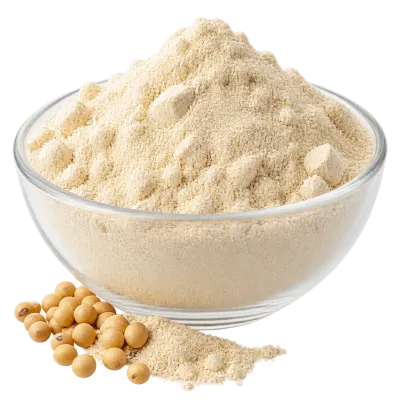
Leucine is found in practically all protein-containing foods, and it is particularly abundant in animal protein sources as well as in certain plant sources such as soybeans.
| Food (per 100 g) | Leucine, approx. |
|---|---|
| Chicken breast | about 1.7 to 1.9 g |
| Beef | about 1.6 g |
| Tuna | about 1.8 g |
| Cheese (hard cheese) | about 2.4 g |
| Soybeans, dried | about 2.8 g |
| Lentils, dried | about 1.7 g |
| Eggs | about 1.1 g |
| Low-fat quark | about 1.0 g |
As a rule of thumb, a portion with around 25 to 30 g of high-quality protein from meat, fish, dairy products or eggs is usually enough to reach the leucine threshold mentioned above. If you eat mainly plant-based, you should plan somewhat larger portions or deliberately include leucine-rich sources such as soy products, as plant proteins on average supply somewhat less leucine per gram of protein than animal ones.
In practical terms for everyday life: a balanced meal with a palm-sized portion of meat, fish or an equivalent plant-based alternative usually already provides enough leucine to stimulate muscle protein synthesis effectively, with no special calculation or additional supplement.
 Matching productSoy Protein IsolateAmazon →
05
Leucine in supplements
On the label, you will find leucine either as a separate ingredient or as part of the amino acid profile of a protein powder. A look at the ingredients list helps you judge whether a product has been deliberately enriched with extra leucine.
Isolated leucine is offered both as a stand-alone powder and as a component of whey protein, BCAA and EAA products. Among common protein sources, whey protein is regarded as particularly rich in leucine, which is one reason for its popularity in strength training.
For most people who already get enough high-quality protein from their diet, an additional isolated leucine supplement brings no clear added benefit over an adequate overall protein intake, for example as part of a nutrition plan for muscle building. A supplement can make sense in specific situations, such as a low appetite, in older age or with a mainly plant-based diet that provides comparatively little leucine per meal. Dietary supplements do not replace a balanced diet, but can at most complement it in a targeted way.
 Matching productWhey Protein ConcentrateAmazon →

06
What the research says
The role of leucine as a trigger of muscle protein synthesis is among the better-established findings in sports nutrition research. Numerous studies show that a meal with sufficient leucine stimulates protein synthesis more strongly than a comparable amount of protein with little leucine.
It is less clear whether an additional, isolated dose of leucine on top of an already adequate protein intake measurably improves muscle building over longer periods. Studies on this point give mixed results, and a clear added benefit beyond an adequate overall amount of protein cannot be reliably derived from them. The best-supported benefit is that of leucine-rich protein sources in older age, where they may help counteract the declining sensitivity of muscle, although here too the evidence is not consistent.
 Matching productWhey IsolateAmazon →
07
Frequently asked questions
How much leucine do I need per meal?
As a guide, research cites around 2 to 3 g of leucine per meal, which can usually be reached with a normal protein-rich meal.
Is more leucine automatically better for building muscle?
No, above the threshold the additional effect is limited. What matters most is an adequate overall intake of all essential amino acids over the day.
Which foods provide particularly high amounts of leucine?
Meat, fish, dairy products, eggs and soybeans are among the foods richest in leucine, measured against their protein content.
Does everyone benefit from a leucine supplement?
With an adequate protein intake it is usually not necessary, but it can be a useful addition with a low appetite, in older age or with a mainly plant-based diet.
Is one leucine-rich meal enough on its own for building muscle?
No, what always counts is the whole: regular strength training, an adequate total protein intake across the day and a suitable overall calorie balance. Leucine is only one building block among several.
Is a separate leucine powder better than whey protein?
Not in general. Whey protein already naturally provides comparatively a lot of leucine together with the other amino acids, and an isolated leucine powder is more relevant for specific questions.
 Matching productVitamin C PowderAmazon →
Explore
Read next
 Protein types at a glance: whey, casein, plant-based and moreAn overview of all common protein types from whey to collagen, with a comparison table and links to detailed guides.
 Amino Acids: The Building Blocks of ProteinStructure, classification and functions of amino acids at a glance, with a table of all 20 proteinogenic amino acids and links to all guide…
 Supplements for Sport and Fitness: A Factual OverviewAll supplement categories at a glance, with the evidence rated from good to thin, plus safety and buying tips.