
6 min read
Isoleucine: Effects, Requirement and Sources of the Essential Amino Acid
What the essential amino acid isoleucine does in the body, roughly how much you need and which foods contain it.

Isoleucine is one of the essential amino acids and one of the three branched-chain amino acids (BCAAs), together with leucine and valine. Essential means that your body cannot make isoleucine itself and therefore has to take it in regularly through food.
In this guide you will learn what roles isoleucine plays in the body, roughly how high the requirement is, which foods contain the amino acid and what role it plays in sports nutrition and dietary supplements.
01
What isoleucine is and why it is essential
Isoleucine is a proteinogenic amino acid, meaning it is a building block from which the body's own proteins are made. Chemically, isoleucine is one of the branched-chain amino acids, known as BCAAs, because its side chain is branched rather than straight. This structure means that, unlike many other amino acids, isoleucine can be metabolised not only in the liver but also directly in the muscles.
As an essential amino acid, isoleucine cannot be rebuilt from other building blocks by the human metabolism. An adequate supply through high-protein foods or, where appropriate, through dietary supplements is therefore necessary so that this amino acid is available to the body for its many tasks.
 Matching productEAA PowderAmazon →
02
Roles of isoleucine in the body
Isoleucine is involved in a large number of metabolic processes. As a building block of muscle and other body proteins, it contributes to muscle protein synthesis, that is, the building and maintenance of muscle tissue. Together with leucine and valine, isoleucine is often discussed in sports science in connection with recovery after training.
In addition, isoleucine can play a role in energy metabolism, since branched-chain amino acids can be used as an additional energy source under certain conditions, for example during prolonged physical exertion or an inadequate carbohydrate intake. Isoleucine is also linked to the regulation of blood sugar levels, although the exact mechanisms are still a subject of research.
Amino acids such as isoleucine are also considered relevant for the immune system and wound healing, as they are involved in forming immune proteins and new tissue. A balanced intake of all essential amino acids, not of isoleucine alone, is regarded as a prerequisite for a functioning metabolism.
Compared with leucine, which research regards as a particularly strong trigger of muscle protein synthesis, isoleucine is seen more as a supporting factor that works together with the other essential amino acids rather than showing a pronounced effect on its own. This interplay of several amino acids is one reason why complete protein sources in the diet usually make more sense than focusing on a single amino acid.
 Matching productL-LeucineAmazon →
03
Requirement and reference values
The requirement for isoleucine is usually considered in relation to total protein intake, not in isolation. If you meet your general protein requirement, for example with the amount of about 0.8 grams of protein per kilogram of body weight per day recommended by the DGE (German Nutrition Society), you will usually take in enough isoleucine automatically, provided your diet is varied.
In strength training and during diets, sports science often cites higher protein amounts of about 1.2 to 2.0 grams per kilogram of body weight. For people aged 65 and over, an intake of about 1.0 gram per kilogram is often recommended, as the body tends to use protein less efficiently with age. In all cases, these values are a rough guide and do not replace individual advice.
Scientific estimates of the isoleucine requirement of individual amino acids do exist, but they are hardly used in practice, because a mixed, high-protein diet almost automatically supplies all essential amino acids in a suitable ratio. More important than the exact amount of isoleucine is therefore to spread enough different protein sources across the day, for example over several meals rather than one large serving.
Special situations such as intensive training phases, injuries or a calorie-reduced diet can increase the total protein requirement and thus indirectly also the isoleucine requirement. Here too, there is no blanket figure for everyone: individual factors such as body composition, training volume and state of health play a role, which is why nutrition counselling makes more sense than a rigid rule if in doubt.
04
Isoleucine in foods
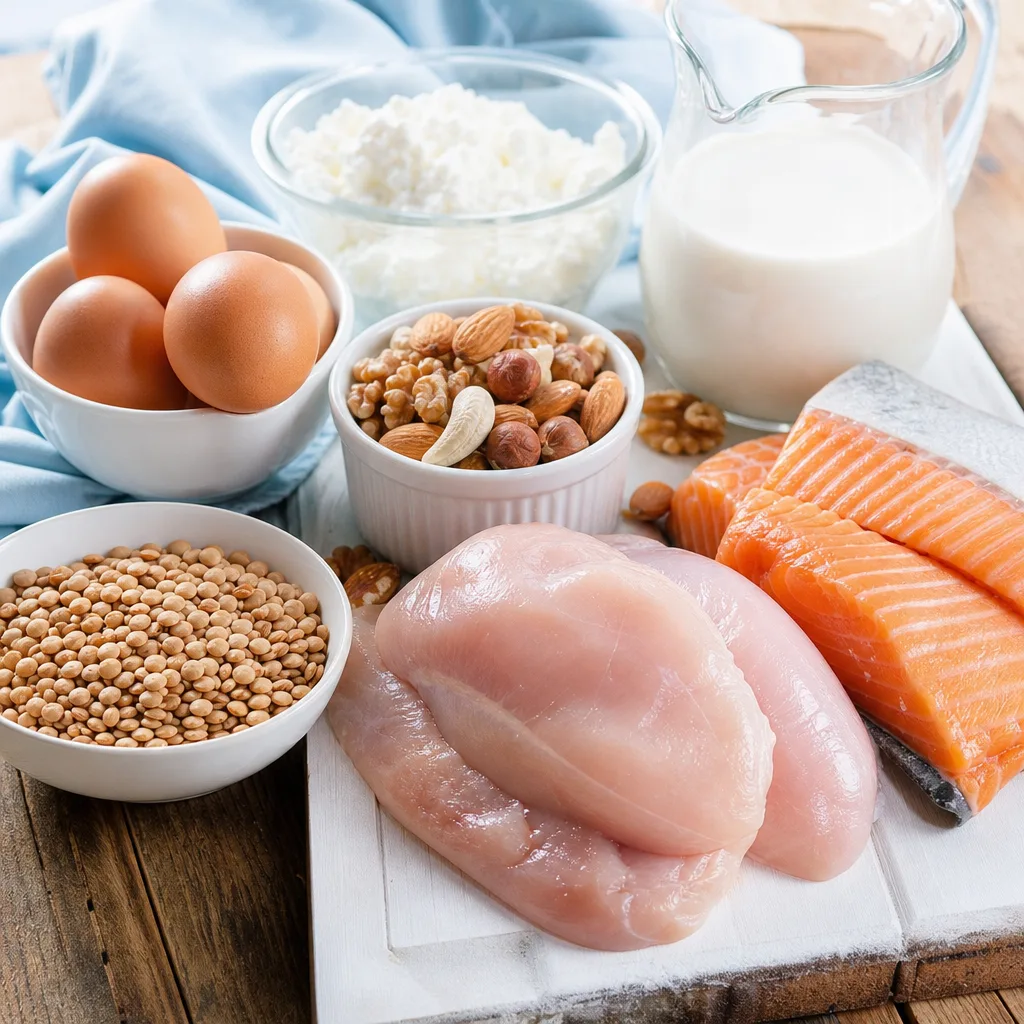
Isoleucine occurs in both animal and plant high-protein foods. Particularly high amounts are found in meat, fish, eggs and dairy products, but legumes, nuts and wholegrain cereals also provide notable amounts.
| Food | Typical isoleucine content per 100 g (rough order of magnitude) |
|---|---|
| Chicken breast | about 1.3 to 1.5 g |
| Tuna | about 1.1 to 1.3 g |
| Eggs | about 0.7 to 0.9 g |
| Low-fat quark | about 0.5 to 0.7 g |
| Lentils, cooked | about 0.4 to 0.5 g |
| Rolled oats | about 0.4 to 0.5 g |
| Almonds | about 0.7 to 0.8 g |
These figures are typical orders of magnitude and can vary depending on variety, preparation and source. If you eat a varied diet with different protein sources, you will as a rule meet your isoleucine requirement without targeted supplementation.
Dairy products such as cheese and yoghurt, as well as soy products, are also among the foods with a notable isoleucine content. If you eat few animal products, you can still achieve a good supply through a targeted combination of legumes, cereals, nuts and soy products, as the amino acid profiles of different plant sources complement each other well.
 Matching productSoy Protein IsolateAmazon →
05
Role in sports nutrition and supplements
Isoleucine is a fixed component of many BCAA supplements and of more comprehensive EAA products, which contain all the essential amino acids. In such products, isoleucine is usually present in a fixed ratio to leucine and valine, and a ratio in which leucine makes up the largest share is often cited.
In practice, it is mainly strength and endurance athletes who use such products, often around training, on the assumption that they support recovery and muscle building. What matters here: if you already take in enough protein through your diet, you usually already meet your isoleucine requirement through protein powder or normal meals, so an isolated supplement is mainly a question of convenience and personal preference.
Some products also advertise isoleucine in connection with blood sugar metabolism during training. Such claims should be viewed with caution, as the underlying research mostly comes from controlled study conditions and cannot simply be transferred to the everyday life of every individual. Such a supplement is in no case a substitute for a generally balanced diet.
 Matching productWhey IsolateAmazon →
06
What the research says
The fundamental role of isoleucine and the other branched-chain amino acids in protein metabolism is considered well established. The evidence is less clear, however, when it comes to the additional benefit of isolated BCAA supplements compared with an overall adequate protein intake. Some research suggests that the effect of isolated BCAAs on muscle building is smaller when enough total protein, and thus enough isoleucine from complete protein sources, is taken in anyway.
There is also research on the role of isoleucine in blood sugar metabolism, but the results are mixed and cannot easily be translated into concrete recommendations. Overall: isoleucine is a necessary building block of metabolism, but neither healing claims nor blanket performance gains can be derived from the current evidence. Dietary supplements are not a substitute for a balanced diet.
Many of the frequently cited statements about BCAAs and muscle building originally come from studies in which the participants' total protein intake was not optimal. In people who already take in enough protein from complete sources, the additional benefit of isolated BCAA supplements tends to be smaller in more recent studies than was previously assumed.
 Matching productAll-in-One Muscle BuilderAmazon →
07
Frequently asked questions
Is isoleucine the same as leucine
No. Isoleucine and leucine are two different but chemically related branched-chain amino acids. Both belong to the BCAA group, but they partly take on different functions in metabolism and occur in foods in different amounts.
Do I need an isoleucine supplement in addition to a normal diet
With a balanced, high-protein diet, a targeted extra portion of isoleucine is usually not necessary. Whether a supplement makes sense for you depends on your individual dietary situation, and if in doubt, advice from a professional can help.
Can too much isoleucine be harmful
An overdose from normal foods is practically ruled out. For heavily dosed supplements, as with all dietary supplements: use the information on the packaging as a guide, and talk to a doctor beforehand if you have a medical condition, are pregnant or are taking medication.
Which plant foods contain a lot of isoleucine
Legumes such as lentils and chickpeas, wholegrain cereals, nuts and seeds provide notable amounts of isoleucine. If you eat a vegan diet, you can achieve a complete amino acid profile by combining different plant protein sources.
 Matching productPea ProteinAmazon →
Explore
Read next
 Protein types at a glance: whey, casein, plant-based and moreAn overview of all common protein types from whey to collagen, with a comparison table and links to detailed guides.
 Amino Acids: The Building Blocks of ProteinStructure, classification and functions of amino acids at a glance, with a table of all 20 proteinogenic amino acids and links to all guide…
 Supplements for Sport and Fitness: A Factual OverviewAll supplement categories at a glance, with the evidence rated from good to thin, plus safety and buying tips.