
8 min read
Creatine: Effects, Dosage and the Main Myths Checked
How creatine works in muscle, why a loading phase is not necessary and what is really behind the myths about kidneys and water retention.

Creatine is one of the best-studied dietary supplements in strength and endurance sport. Unlike many other supplements, the evidence here is comparatively clear: regular intake can support strength performance in training, and the usual way of taking it is straightforward.
In this guide you will learn how creatine works in the body, which amount is usual in sports science, why a loading phase is not necessary and what is actually behind the common myths about kidneys and water retention.
01
What is creatine and how does it work in the body
Creatine is a substance produced by the body from the amino acids arginine, glycine and methionine. The body makes a certain amount itself every day in the liver, kidneys and pancreas, and also takes in creatine from meat and fish. It is stored mainly in skeletal muscle, with a smaller share also in the brain and heart.
In muscle, creatine exists partly free and partly as creatine phosphate. Creatine phosphate serves as a fast energy buffer: it helps to quickly replenish used-up ATP, the cell's central energy currency. This is exactly the mechanism needed in short, intense efforts, such as a heavy set of squats or a sprint, where the energy demand is very fast and very high.
02
The effect in strength training
For strength performance in training, creatine is one of the best-supported dietary supplements there is. Numerous studies over recent decades consistently show that regular intake can slightly to moderately increase maximum strength and the number of possible repetitions in short, intense efforts. This is because the additional intake lets muscle cells store more creatine phosphate, so a little more energy is immediately available in fast, strength-intensive movements.
This is usually not noticeable straight away but over several weeks of training. If you manage a few more repetitions or train slightly heavier, you also tend to build a little more muscle mass over time. Creatine does not replace training or adequate protein intake, but it can usefully support consistent strength training with suitable protein intake.
Besides classic strength sport, creatine is also studied in short, repeated sprint efforts, for example in team sports with frequent accelerations and changes of direction. In pure endurance efforts over longer periods, the benefit is much smaller, because other energy systems dominate there and storage capacity for creatine phosphate is hardly the limiting factor.
It is also important to note that not every body responds equally strongly to additional intake. If you already eat a lot of meat and fish, your muscle stores are often comparatively well filled and you will notice an additional effect that is correspondingly more modest. With a diet low in meat, supplementation makes a somewhat clearer difference on average, because baseline stores are lower.
 Matching productSports BraAmazon →

03
Dosage: 3 to 5 g monohydrate daily, no loading phase needed
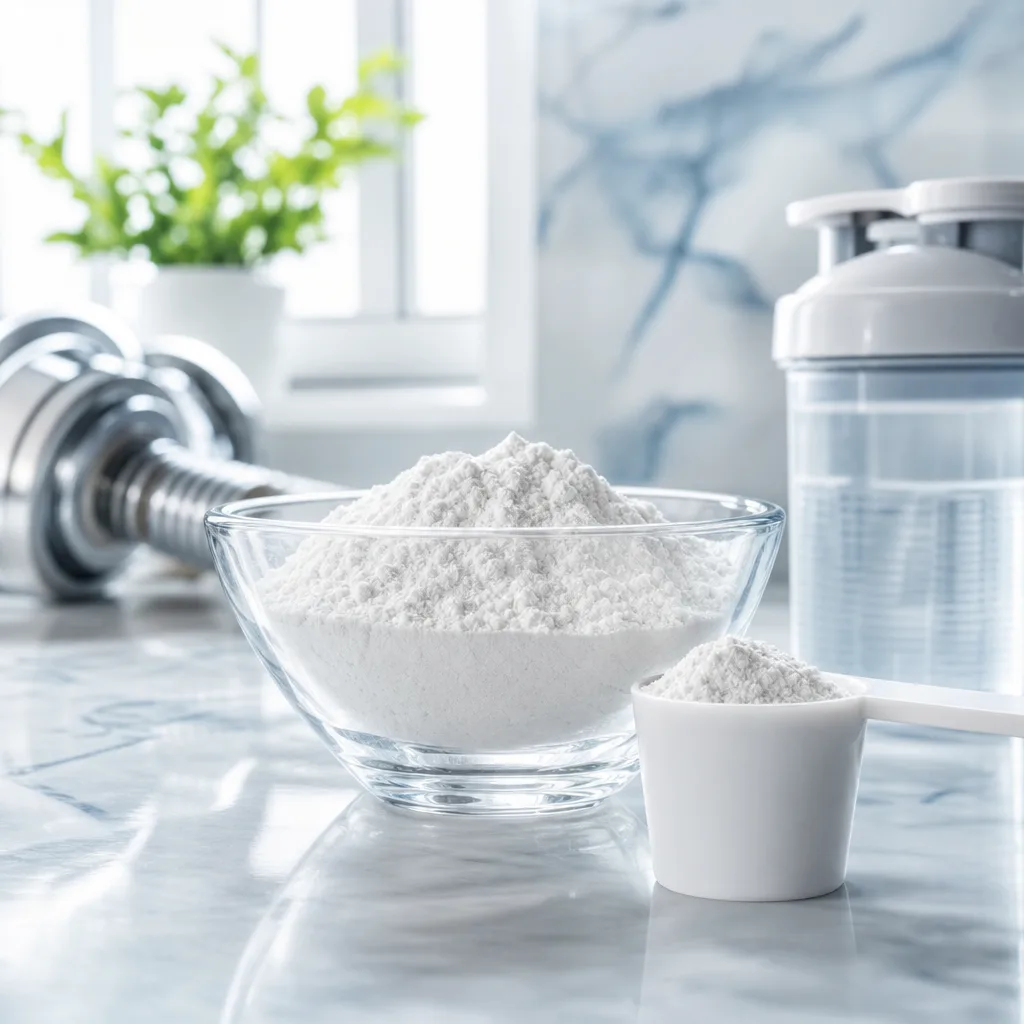
In sports science, an amount of about 3 to 5 g of creatine monohydrate per day has become established as the usual guide for long-term use. This amount is generally enough to fill the muscle creatine stores over a few weeks and then keep them at a higher level. For exact instructions on intake, it is best to consult the leaflet or label of your product.
In the past, a so-called loading phase was often recommended: a markedly higher amount for a few days, spread over several portions, followed by a lower maintenance dose. A loading phase can fill the stores somewhat faster, but it is not necessary for the end result after a few weeks. With about 3 to 5 g daily, the same degree of muscle store saturation is reached, only a little more slowly, and less often accompanied by the digestive complaints that occasionally occur with a loading phase.
The timing of intake plays a minor role in the effect. Many people take creatine after training, together with a meal containing carbohydrates or protein, because this may slightly favour uptake into the muscle cell. In the end, what matters most is regular daily intake, regardless of the exact time of day.
| Food | Creatine per 500 g (typical order of magnitude) |
|---|---|
| Beef | about 2 g |
| Pork | about 2.5 g |
| Salmon | about 2 g |
| Herring | about 3.5 g |
| Tuna | about 2 g |
If you follow a vegetarian or vegan diet, you take in practically no creatine through food, because plant foods contain hardly any. The body does make some itself, but on this kind of diet muscle stores tend to be lower on average, which makes supplementation particularly interesting for this group.
In strength sport and for targeted muscle building, too, creatine is one of the few supplements with truly consistent evidence. In addition, some studies suggest that older people, in combination with strength training, may benefit in preserving muscle mass, although less data is available here than for young, trained adults.
Creatine can also be a sensible addition for athletes who train at high intensity several times a week and often feel somewhat tired or drained, provided training and diet are right overall. For recreational athletes with one or two easy sessions per week, by contrast, the expected effect is rather small, because the training intensity needed for a noticeable effect is usually lacking.
 Matching productPea ProteinAmazon →

04
Monohydrate or other forms
Besides creatine monohydrate, many other forms are on the market, such as buffered creatine, esters or various salts. They are often advertised with better tolerability or a stronger effect. In research, however, monohydrate is by far the best-studied and most reliable form. So far, there is no convincing evidence that other variants are actually superior to monohydrate.
Monohydrate is also chemically stable and dissolves well in water or juice, even though a fine sediment is normal. A fine, micronised powder generally dissolves a little more easily than coarsely ground powder.
The form of administration also plays no decisive role in the effect itself. Whether powder, capsule or chewable tablet, what ultimately matters is the amount of creatine monohydrate actually taken in per day. Powder has the practical advantage over capsules that the amount is easy to adjust to the instructions on your own packaging.
 Matching productKre-AlkalynAmazon →
05
Myths checked: kidneys and water retention
Two concerns come up particularly often with creatine: possible strain on the kidneys and unwanted water retention in the face or body. Both merit a closer look.
In healthy people without existing kidney disease, studies over several years show no harmful effect of creatine at the usual amounts on kidney function. The often-cited rise in creatinine in the blood is not a sign of damage but a normal measurement effect, because creatine is broken down to creatinine in the body. If you already have kidney disease or are unsure, you should still have your intake checked by a doctor beforehand.
On water retention: creatine can indeed cause a little more water to be stored in the muscle cells, which explains part of the weight gain in the first weeks of use. This is water inside the muscle cell, not visible water retention under the skin or in the face, as can occur with a very salty diet, for example. A puffy appearance caused by creatine is not supported by research.
06
Side effects and who should be cautious
At the usual dosage of about 3 to 5 g daily, creatine is considered well tolerated. Occasionally, mild digestive complaints such as bloating are reported at the start of use, especially when it is taken on an empty stomach with little fluid. Drinking enough fluid spread across the day can counteract this.
If you have existing kidney or liver disease, are pregnant or breastfeeding, or take medication, it is best to discuss use with a doctor beforehand. Dietary supplements such as creatine do not replace a balanced diet; where there is a corresponding need, they can only complement it sensibly.
Children and adolescents who are still growing should also not take creatine without first consulting a doctor, as far fewer studies exist for this age group than for adult athletes. For healthy adult recreational and competitive athletes, by contrast, there is no indication of increased risk at the usual dosage.
07
What the research says
Creatine is one of the longest and most extensively studied supplements in sport. Several sports nutrition societies rate the evidence for short-term gains in strength and performance in intense, short efforts as well established. The effect is real but moderate: creatine does not turn average training into a top result, but under favourable conditions it can slightly support existing strength and sprint training.
The evidence is less clear for some additional fields of use, for example mental performance under sleep deprivation or in older people combined with strength training. Individual studies point to possible benefits here, but a final assessment is still pending. In any case, one thing remains important: creatine works only in combination with actual training; without a training stimulus, the effect on muscle stays small.
What remains credible here above all is the sober assessment: creatine is not a miracle product and replaces neither a training plan nor a balanced diet, but it is one of the few dietary supplements whose effect and safety have been comparatively consistently documented over many years and numerous studies. This combination of good proof of effect and good tolerability explains why creatine has such a firm place in sports nutrition.
08
Frequently asked questions
Is a loading phase necessary with creatine?
No. A daily amount of about 3 to 5 g monohydrate fills the muscle stores within a few weeks even without a loading phase. The loading phase merely speeds up this process; it is not required for the end result.
Does creatine harm the kidneys?
In healthy people, the available studies show no harmful effect on kidney function at the usual dosage. If you have existing kidney disease, use should be discussed with a doctor beforehand.
Does creatine cause water retention in the face?
Creatine stores some water in the muscle cells, which can show up as a slight weight gain at the start. A puffy face or visible water retention under the skin, however, is not supported.
Can I take creatine long term?
Continuous use over longer periods is considered safe in the available studies. Short breaks are possible but not strictly necessary. Drinking regularly throughout the day remains sensible anyway, regardless of creatine intake.
Is creatine also suitable for women?
Yes. The mechanisms of action are comparable in women and men, even though many studies have historically been carried out more on male athletes.
Explore
Read next
 Protein types at a glance: whey, casein, plant-based and moreAn overview of all common protein types from whey to collagen, with a comparison table and links to detailed guides.
 Amino Acids: The Building Blocks of ProteinStructure, classification and functions of amino acids at a glance, with a table of all 20 proteinogenic amino acids and links to all guide…
 Supplements for Sport and Fitness: A Factual OverviewAll supplement categories at a glance, with the evidence rated from good to thin, plus safety and buying tips.