
7 min read
Full-Body Workout Plan for Beginners: Structure and Exercises
A full-body workout plan for beginners with an exercise table, suitable equipment and notes on technique and progression.

Anyone new to strength training often faces the question of what a sensible first plan should even look like. A full-body workout plan is considered a proven starting point for beginners, because it works all the large muscle groups in one session and fits well into everyday life with two to three training days per week.
In this guide you will learn how a full-body plan for beginners is structured, what equipment you need, how to dose the exercises correctly and what to pay attention to in your nutrition around training.
01
Why Full-Body Training Makes Sense for Getting Started
At the start, the question is usually not how to train individual muscles in as isolated a way as possible, but how to build a solid base of strength, technique and movement awareness in the first place. A full-body plan covers legs, back, chest, shoulders and core in every session and thereby provides a balanced load, without individual areas being neglected for weeks on end.
Another advantage lies in exercise frequency: because each large muscle group is worked two to three times per week, the body learns the movement patterns faster than if each group only had its turn once a week. For beginners this is especially valuable, because technique in exercises such as the squat, deadlift or row only becomes established through repeated practice.
Full-body training is also easy to reconcile with a still irregular daily routine. If a session falls through, no entire muscle group goes without for a week, as can be the case with plans that are split more heavily. Another practical aspect concerns scheduling: because a single session covers all the large muscle groups, a few but consistently kept training appointments per week are often enough for first noticeable progress, which makes getting started easier in a busy life.
From a psychological point of view, too, the full-body approach has an advantage: people who feel after every session that they have really worked the whole body find it easier, in experience, to stay motivated than when individual sessions concentrate on small muscle groups and the effect is less immediately noticeable. For many beginners, precisely this feeling of having achieved something noticeable in a short time is an important building block for sticking with it in the long run.
 Matching productWhey IsolateAmazon →

02
The Training Plan at a Glance
The following plan is designed for two to three sessions per week with at least one rest day in between. The exercises can be done with dumbbells, a barbell or in part with machines, depending on what is available to you.
| Exercise | Sets | Repetitions | Rest |
|---|---|---|---|
| Squat or leg press | 3 | 8 to 12 | about 90 seconds |
| Bent-over row or machine row | 3 | 8 to 12 | about 90 seconds |
| Bench press or push-up | 3 | 8 to 12 | about 90 seconds |
| Dumbbell shoulder press | 2 | 10 to 12 | about 60 seconds |
| Romanian deadlift or hip thrust | 2 | 10 to 12 | about 60 seconds |
| Plank or forearm plank | 2 | 20 to 40 seconds | about 45 seconds |
There should be at least one rest day between training days so that the muscles worked can recover. If you start with two sessions per week, you can increase to three sessions after a few weeks, once technique and general resilience have become established. You will find more on gradually increasing training load in the guide Progressive Overload, and on a sensible warm-up before every session in the guide Warming Up and Mobility.
03
What You Need
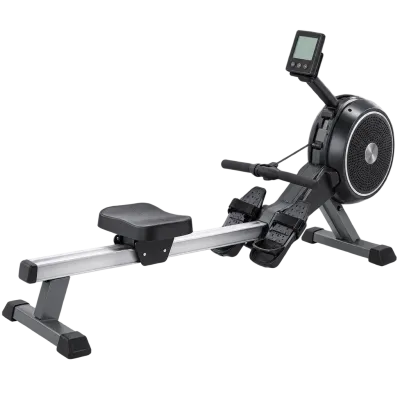
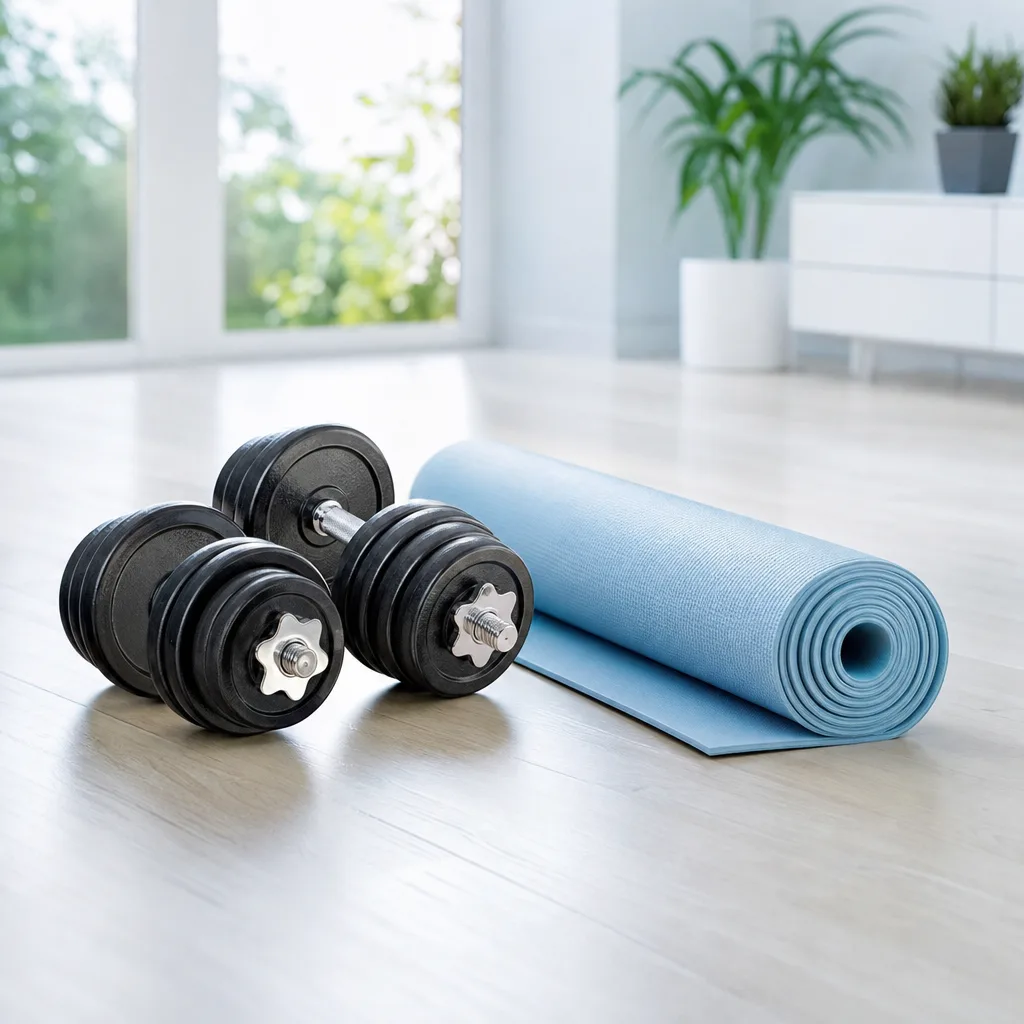
To get started, often very little equipment is enough. A pair of dumbbells with adjustable weight covers most exercises, from the weighted squat to the shoulder press. A non-slip training mat is pleasant for floor exercises such as the plank, and stable training shoes with a firm sole provide a secure stance for squats and deadlifts. If you train in a gym, you also have access to a barbell, a rowing machine and a leg press, which makes getting into some exercises easier. A water bottle is also part of the basic kit, so that you can take in enough fluid during training. If you want to train at home, you will find further notes in the guide Setting Up a Home Gym.
 Matching productRowing MachineAmazon →
04
Nutrition to Go with It
Strength training alone is not enough for building muscle; nutrition plays a role too. You can find out roughly how high your personal protein requirement is as a beginner in the guide Protein Requirement. If you want to build muscle in a targeted way, you will find further information in the guide Protein for Muscle Building. Dietary supplements can sensibly complement a balanced diet, but they do not replace it.
05
Technique Before Weight
Especially at the beginning, it is worth learning the movements cleanly with light weights first, before increasing the load. Clean execution protects joints and spine and lays the foundation for being able to move more weight in the long run without getting injured. If you are unsure whether your technique is right, you can initially have experienced lifters or trainers in the gym guide you, or use videos as orientation.
After a few weeks of stable technique, you can begin to raise the weight in small steps, as soon as you manage the upper repetition number in the given range cleanly. This principle of slow progression is called progressive load management and is a central building block for visible progress over months.

06
Common Mistakes and Next Steps
A common mistake is to load too much weight too quickly, before technique is secure. This not only increases the risk of injury but also often leads to an inefficient movement pattern that is harder to correct later. Just as common is the opposite mistake: out of uncertainty, training permanently with very light weights without increasing the load at all, so that over time the training stimulus becomes too small to trigger further progress. Skipping the warm-up before the actual session is also one of the common beginner mistakes, even though with unfamiliar movements such as the squat or deadlift a short, targeted warm-up can noticeably lower the risk of injury.
A good plan also achieves little if it is only implemented irregularly. Especially in the first weeks, it makes more sense to commit to two fixed, easily plannable training days per week than to aim for three sessions and regularly let one of them fall through. After a few months on a full-body plan, many people who train notice that sessions become noticeably longer once more exercises and sets are needed to keep setting a sufficient training stimulus. This is a typical signal that a switch to a more heavily split structure can become sensible, for example to a 3-day split or an upper-lower split with more training days per week. Until then, it is worth patiently sticking to the full-body plan and consistently increasing the load as soon as technique allows.
 Matching productTraining HoodieAmazon →

07
What the Research Says
In training science it is considered well established that regular strength training with a sufficient training stimulus can build muscle mass and strength, regardless of whether a full-body plan or a more heavily split plan is used. For beginners with limited training frequency, several studies suggest that full-body training is a sensible choice because of the higher frequency per muscle group. How strongly individual training variables such as set count or repetition range affect progress in concrete terms continues to be discussed in research, particularly for advanced lifters. For getting started, however, there is agreement: regular, technically clean training with slow progression of the load leads to measurable progress in most people. Research also gives a clear pointer on recovery: at least 48 hours should lie between two sessions that work the same muscle group, so that the tissue can adapt sufficiently.
08
Frequently Asked Questions
How often should I train as a beginner?
Two to three sessions per week with at least one rest day in between are considered a good start. More important than frequency is initially regular implementation over several weeks.
How long does a session on this plan take?
Depending on rest length and warm-up time, a session usually takes about 45 to 60 minutes. At first it may take somewhat longer until the order of exercises has settled in.
When should I increase the weight?
As soon as you reach the upper repetition number with clean technique in all sets, you can raise the weight in small steps. When in doubt, increase more slowly rather than too fast.
Do I have to warm up for a long time before every session?
A short, targeted warm-up of about 5 to 10 minutes is usually enough to prepare joints and muscles for the load. You will find details in the guide Warming Up and Mobility.
What if I have health limitations?
If you have pre-existing conditions, are pregnant or have had a long break from training, you should seek medical advice before starting and, if necessary, have the plan adapted.
Explore
Read next
 Protein types at a glance: whey, casein, plant-based and moreAn overview of all common protein types from whey to collagen, with a comparison table and links to detailed guides.
 Amino Acids: The Building Blocks of ProteinStructure, classification and functions of amino acids at a glance, with a table of all 20 proteinogenic amino acids and links to all guide…
 Supplements for Sport and Fitness: A Factual OverviewAll supplement categories at a glance, with the evidence rated from good to thin, plus safety and buying tips.