
7 min read
Push, Pull, Legs: A Workout Plan Based on Movement Direction
How a push pull legs plan is structured, which exercises belong in it and how to distribute the three sessions sensibly across the week.

Push, pull, legs is one of the best-known ways of splitting training in strength sport. Instead of sorting by body region, it sorts by movement direction: pushing movements on one day, pulling movements on another and leg training on a third. This logic means that muscle groups that work together in an exercise anyway are also worked on the same day.
In this guide you will learn how a push pull legs plan is structured, what equipment you need for it, how the three sessions can be distributed sensibly across the week and what research says about this split.
01
The Principle of Push, Pull and Legs
In push training the focus is on pushing movements, such as the bench press, shoulder press and triceps exercises. Pull training follows with pulling movements such as rows, pull-ups and biceps exercises. The third day is reserved for leg training, with exercises such as the squat, deadlift and calf raise. Since muscles such as the triceps in the bench press or the biceps in the row work along as assisting muscles anyway, in this split they are not heavily loaded twice on different days, which makes recovery easier.
This logic distinguishes push, pull, legs from splits by body region such as a classic 3-day split. While there, for example, chest and triceps are trained together because they lie in the same body region, push, pull, legs follows movement direction consistently, regardless of which body region the muscles involved lie in. For many people who train, this principle feels intuitive, since individual exercises can be clearly assigned to one of the three categories.
Push, pull, legs is particularly suited to people who train and can plan for three to six sessions per week, since with greater availability the cycle can also be run through twice a week.
Another practical advantage of this logic shows in recovery within the week: since on a push day mainly chest, shoulders and triceps tire, while on a pull day it is back and biceps, the load barely overlaps between days. This makes it possible to do the sessions on consecutive days as well, without a muscle group that is already exhausted being heavily demanded again the next day.
 Matching productL-GlutamineAmazon →

02
The Training Plan at a Glance
| Day | Exercise | Sets | Repetitions | Rest |
|---|---|---|---|---|
| Push | Bench press | 4 | 6 to 10 | about 2 minutes |
| Push | Shoulder press | 3 | 8 to 12 | about 90 seconds |
| Pull | Pull-ups or lat pulldown | 4 | 6 to 10 | about 2 minutes |
| Pull | Cable row | 3 | 8 to 12 | about 90 seconds |
| Legs | Squat | 4 | 6 to 10 | about 2 minutes |
| Legs | Romanian deadlift | 3 | 8 to 12 | about 90 seconds |
If you run through the cycle twice a week, you train each muscle group twice in total, which is often described in training science as advantageous for building strength and muscle. You can read more about dosing training load correctly over the weeks in the guide Progressive Overload, and about the importance of rest days in the guide Recovery and Sleep.
In addition to the main exercises listed in the table, each of the three training days can be extended by one or two supplementary exercises, such as isolation movements for shoulders, calves or the lateral abdominal muscles. To get started, however, it is enough to concentrate first on the basic exercises listed and learn them cleanly before adding further exercises to the programme.
03
What You Need
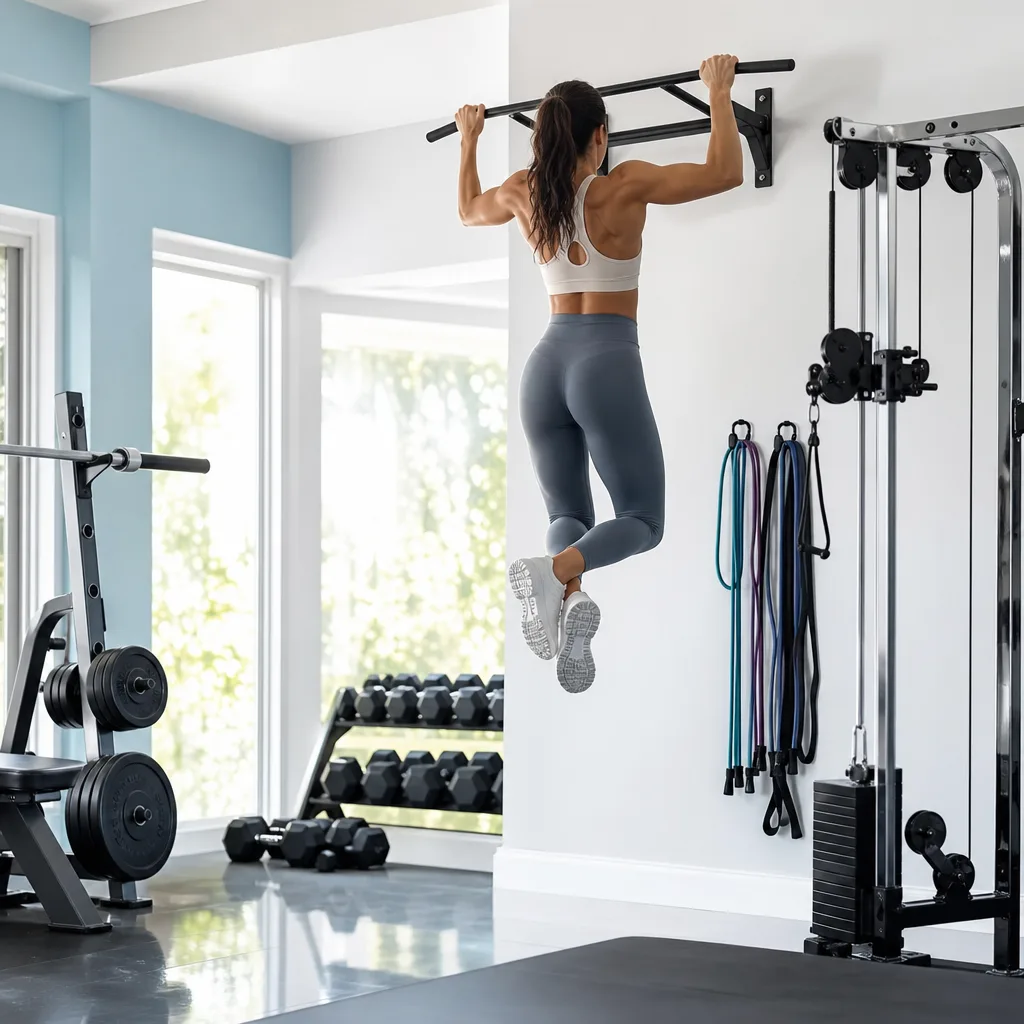
For a classic push pull legs plan, a barbell, dumbbells and a pull-up bar are the central equipment, supplemented by a cable machine or resistance bands for pulling exercises. In a gym, machines are also available that make individual movements easier. Firm training shoes are important for leg days, and a lifting strap can help you hold your grip longer in intense pulling exercises such as pull-ups or deadlifts. If you train at home, you will find further notes for the pull part in the guide Pull-Up Bar Training. For the push part without a gym, push-up handles and an adjustable weight bench are also suitable, allowing the bench press and shoulder press to be performed cleanly at home as well. If you build up your equipment gradually, it is best to start with the equipment that can be used on all three training days, such as a set of dumbbells with adjustable weight, before more specialised equipment such as a pull-up bar or a cable machine is added.
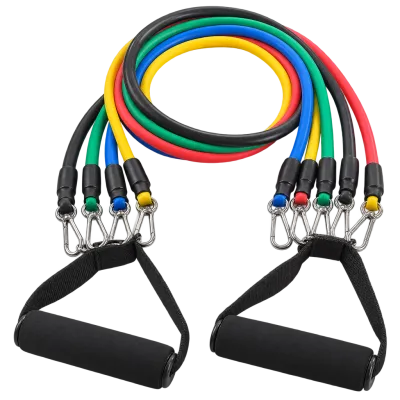 Matching productResistance BandsAmazon →
04
Nutrition to Go with It
With a split of three to six sessions per week, the need for enough protein across the day rises to support recovery and muscle building. The guide Calculating Your Protein Requirement explains how to roughly estimate your personal protein requirement. You will find further notes in the guide Protein for Muscle Building. Dietary supplements can sensibly complement nutrition, but do not replace a balanced diet. With six sessions per week, it is also worth checking that your overall calorie intake is sufficient, since too large a deficit combined with high training volume can make recovery considerably harder.
 Matching productAll-in-One Muscle BuilderAmazon →
05
Flexibility in Weekly Planning
One advantage of push, pull, legs is the flexibility in distributing it across the week. With three sessions, one run-through with rest days in between is enough; with six sessions the cycle can be run through twice in a row, usually with an additional rest day at the end of the week. It is important to make sure you get enough sleep and to adapt intensity to your own recovery capacity, rather than rigidly pushing through the sessions regardless of your condition.
If you only have time for training on four days a week, you can also repeat the cycle incompletely, for example push, pull, legs, push in one week and pull, legs, push, pull in the next. In this way the order shifts continuously, and viewed over several weeks each category is trained about equally often, even if the fixed three-day structure does not work out exactly in individual weeks.

06
Common Mistakes and Practical Tips
A common mistake with push, pull, legs is to neglect leg day compared with push and pull sessions, whether from lack of time or because leg exercises are felt to be more strenuous. Since the leg muscles make up a large part of total muscle mass, it is worth giving leg day the same importance as the other two sessions. Another point is the order of exercises within a session: basic exercises such as the bench press, pull-ups or squat should come at the beginning, when strength reserves are still highest, with isolation exercises for smaller muscle groups following afterwards.
If you run through the cycle twice a week, you should also take care not to push intensity to the maximum in every session, but deliberately vary between lighter and heavier days. This makes it easier to train consistently over several weeks without endangering technique or progress through persistent fatigue. Some people who train deliberately plan a lighter training week every six to eight weeks, in which weight and volume are reduced, to allow the body a more pronounced recovery phase before the load is increased again afterwards.

07
What the Research Says
The evidence on the best training frequency per muscle group is not entirely consistent, but tends towards two sessions per week per muscle group often being somewhat more favourable for muscle building than only one session, at the same total volume. Push, pull, legs with a double run-through per week meets this criterion well. Whether the split by movement direction brings a clear advantage over other splits cannot be clearly derived from current research; what seems more decisive is the total training volume achieved and consistent implementation over weeks and months. The exact repetition range within sets is also discussed controversially in research, with indications that both lower and higher repetition counts can lead to comparable muscle building, as long as the sets are performed demandingly enough.
08
Frequently Asked Questions
How often should I train push, pull, legs?
Three sessions per week as a single run-through or six sessions with a double run-through are common variants. It is important to adapt frequency to your recovery capacity rather than rigidly following a fixed number.
Is push, pull, legs suitable for beginners?
In principle yes, although because of the higher training frequency the split is more for people who have already gained basic experience with a full-body plan.
What do I do if a training day is missed?
You can simply make up the missed session on another day and then continue the cycle, without throwing the whole plan off.
Do I need different exercises for each day?
The exercises can stay the same for several weeks as long as you increase the load step by step. Variety is possible, but not strictly necessary for progress.
What if I have health limitations?
If you have pre-existing conditions, are pregnant or have had a longer break from training, you should seek medical advice before starting and have the plan adapted if necessary. This applies especially if you have complaints in the joints or spine.
Explore
Read next
 Protein types at a glance: whey, casein, plant-based and moreAn overview of all common protein types from whey to collagen, with a comparison table and links to detailed guides.
 Amino Acids: The Building Blocks of ProteinStructure, classification and functions of amino acids at a glance, with a table of all 20 proteinogenic amino acids and links to all guide…
 Supplements for Sport and Fitness: A Factual OverviewAll supplement categories at a glance, with the evidence rated from good to thin, plus safety and buying tips.