
7 min read
Workout Plan for Muscle Building: Structure and Principles
How a workout plan for muscle building is structured, which principles count and how training, equipment and nutrition work together.

Anyone who wants to build muscle in a targeted way needs, besides regular training, above all a plan that sets enough stimulus for growth while allowing sufficient recovery. A workout plan for muscle building combines adequate volume, a suitable repetition range and a step-by-step increase in training load over weeks and months.
In this guide you will learn how a muscle-building plan can be structured, what equipment makes sense for it, how nutrition and training work together and what research says about building muscle.
01
Core Principles for Building Muscle
Muscle growth arises as an adaptation to a repeated training stimulus that is increased over time. Three factors play a central role: sufficient training volume, meaning the combination of sets, repetitions and exercises; a training intensity that really challenges the muscle; and sufficient recovery between sessions, so that the body can turn the stimuli set into growth.
Which concrete training plan is used for this is secondary, as long as these three factors are met. Both a full-body plan with two to three sessions per week and more heavily split plans such as a 3-day split or push, pull, legs can be used for building muscle. What matters is that the chosen plan fits your own time budget, training experience and preferred training frequency, since a plan that cannot be implemented consistently contributes little to progress.
A repetition range of about 6 to 15 repetitions per set is often used in practice for building muscle, although ranges outside this span can also lead to progress, as long as the sets are performed demandingly enough. More important than an exact repetition count is consistent, technically clean implementation over a longer period.
Another factor that is often underestimated in practice is how close training comes to muscle failure: sets that are taken close to your own limit without losing technique tend to set a stronger growth stimulus than sets that are stopped well before fatigue. This does not mean that every set must be taken to complete muscle failure, but a noticeably strenuous feeling in the last repetitions is a sensible guide for most goals.

02
The Training Plan at a Glance
The following sample plan is designed for three to four sessions per week with a focus on basic exercises that work several muscle groups at once.
| Exercise | Sets | Repetitions | Rest |
|---|---|---|---|
| Squat | 4 | 6 to 10 | about 2 minutes |
| Bench press | 4 | 6 to 10 | about 2 minutes |
| Bent-over row | 4 | 8 to 12 | about 90 seconds |
| Shoulder press | 3 | 8 to 12 | about 90 seconds |
| Machine leg curl | 3 | 10 to 15 | about 60 seconds |
| Biceps and triceps exercise | 3 | 10 to 15 | about 60 seconds |
Over several weeks you can gradually increase either the weight, the repetition count or the set count to keep the training stimulus constant. This principle is explained in more detail in the guide Progressive Overload. If you are looking for a basic split such as a 3-day split or push, pull, legs, you will find more detailed sample plans for higher training frequencies there.
The plan shown above can also easily be extended with additional exercises for areas that matter to you personally, such as targeted calf exercises or extra ab exercises. It is important to keep the total volume in view, so that the session is not stretched out unnecessarily and the quality of the main exercises does not suffer. As a rough guide: additional exercises should complement the basic exercises, not replace them, since compound exercises such as the squat, deadlift, bench press and row make the largest contribution to the overall stimulus.
03
What You Need
For classic muscle-building training, a barbell, dumbbells and a weight bench are the central equipment, supplemented by a pull-up bar or a cable machine for back exercises. In a gym, machines also widen the choice of exercises. Firm training shoes support a stable stance in squats and deadlifts, and a lifting strap can help with heavier pulling exercises. A water bottle is also part of the basic kit, especially for longer sessions with higher volume. A training log, whether as a notebook or an app, is likewise part of a sensible basic kit, since progress in muscle building can be read mainly from whether weight, repetitions or sets increase over the weeks.
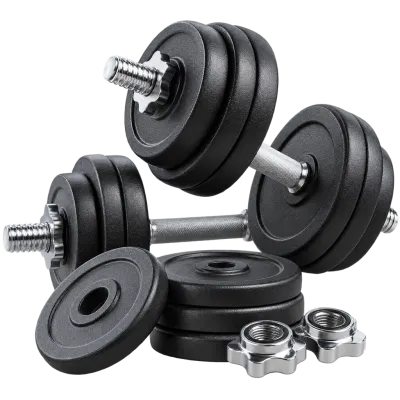 Matching productDumbbell SetAmazon →

04
Nutrition to Go with It
Without sufficient energy and protein intake, the training stimulus often goes unused, because the body lacks the building blocks for muscle growth. The guide Calculating Your Protein Requirement explains roughly how high your protein requirement is, and you will find in-depth notes specifically on building muscle in the guide Protein for Muscle Building. Dietary supplements can sensibly complement a balanced diet, but they do not replace it. Besides the protein amount alone, adequate total energy intake also plays a role, since the body needs additional energy to build new muscle, which must be supplied through food.
05
Patience and Long-Term Planning
Visible muscle growth is a slow process that stretches over months and years, not a few weeks. Instead of hoping for quick results, it is worth implementing the plan consistently over longer periods and increasing the load regularly as soon as technique allows. Enough sleep and planned recovery phases are also part of a successful muscle-building plan, since the actual building takes place in the rest phases between sessions.

06
Common Mistakes in Building Muscle
A common mistake is constantly switching between different training plans and exercises before a plan has had enough time to show any effect. Progress in muscle building usually shows only after several weeks of consistent training, which is why frequent switching tends to be a hindrance. The importance of set quality is also often underestimated: sets that are stopped well before actual fatigue set a smaller training stimulus than sets that are taken close to your individual limit without losing technique.
An unbalanced choice of exercises that neglects individual muscle groups such as the leg muscles or the back also slows overall progress. A balanced plan that addresses all the large muscle groups regularly leads in the long run to more even and more stable muscle growth than a one-sided focus on a few favourite exercises. Last but not least, enough sleep is often underestimated, even though a large part of the physical recovery and adaptation needed for visible muscle growth takes place precisely in the nightly rest phases. Anyone who regularly sleeps too little risks a plan that is well planned in itself not showing the expected effect, even if exercise selection and nutrition are right. Fixed bedtimes and sufficient sleep duration therefore belong to a well-thought-out muscle-building plan just as much as the actual training sessions themselves, even if this connection easily slips into the background in everyday life and often gets less attention than the concrete choice of exercises.
 Matching productL-TryptophanAmazon →

07
What the Research Says
In training science it is considered well established that a sufficient weekly training volume per muscle group, combined with a step-by-step increase in load, leads to muscle growth. How many sets per week are optimal is quantified differently in studies and also depends on individual recovery capacity and training experience, which is why no blanket ideal number can be given. Research also shows that a moderate calorie surplus can support muscle building, while a large calorie deficit makes the process harder. For details on the connection between calories and muscle building, take a look at our guide on protein for muscle building. There is also extensive research on the optimal timing of protein intake around training, although in most studies the total amount of protein across the day proves considerably more important than an exact time of intake.
08
Frequently Asked Questions
How quickly do I build visible muscle?
That varies greatly from person to person and depends on training experience, nutrition and recovery. First noticeable strength gains often show up sooner than visible changes in muscle mass.
Are three sessions per week enough for building muscle?
Yes, three well-structured sessions per week are enough for many people who train to build muscle continuously, provided volume and progression fit.
Do I need a calorie surplus to build muscle?
A moderate surplus can support the process but is not strictly necessary, especially for beginners, who can make progress even with a balanced calorie intake.
How important is sleep for building muscle?
Very important, since the body recovers and builds muscle mainly in rest phases. You will find more in the guide Recovery and Sleep.
Do I have to train every workout to muscle failure?
No, a strenuous feeling in the last repetitions is usually enough. Constantly training to complete muscle failure can put additional strain on recovery over weeks.
What if I have health limitations?
If you have pre-existing conditions, are pregnant or have had a long break from training, you should seek medical advice before starting and have the plan adapted.
 Matching productL-GlutamineAmazon →
Explore
Read next
 Protein types at a glance: whey, casein, plant-based and moreAn overview of all common protein types from whey to collagen, with a comparison table and links to detailed guides.
 Amino Acids: The Building Blocks of ProteinStructure, classification and functions of amino acids at a glance, with a table of all 20 proteinogenic amino acids and links to all guide…
 Supplements for Sport and Fitness: A Factual OverviewAll supplement categories at a glance, with the evidence rated from good to thin, plus safety and buying tips.