
6 min read
Healthy Hair Through Amino Acids: What Is Really Behind It
Keratin, cysteine and arginine are often linked to healthy hair. Here you can find out what amino acids can actually do for your hair.

Dull, brittle hair has many possible causes, from care routines and diet to hormonal or genetic factors. Amino acids are often advertised as the solution, because hair consists largely of the structural protein keratin. This article shows what is scientifically tenable about that and where the limits lie.
Important to say first: in the case of sudden or severe hair loss, a medical check is always worthwhile, since causes such as hormonal, inflammatory or diet-related problems may lie behind it and need targeted treatment.
01
Why amino acids are relevant for hair structure
Hardly any part of the body is observed as closely in daily life as our own hair. Small changes are noticed quickly and are often too hastily attributed to a single trigger. In reality, the condition of hair is usually the result of several factors that add up over weeks and months, which makes a simple explanation difficult. The market for so-called hair vitamins and beauty supplements is correspondingly large, with varied advertising promises of thicker, shinier hair within a few weeks.
Hair care products and dietary supplements are often advertised in the same breath, although they act in completely different places. Care products act from the outside on the hair fibre that has already grown, whereas dietary supplements can at most influence the conditions under which new hair is formed in the hair root. It is also important to keep expectations realistic: even with optimal nutrition, hair grows on average only about one centimetre per month.
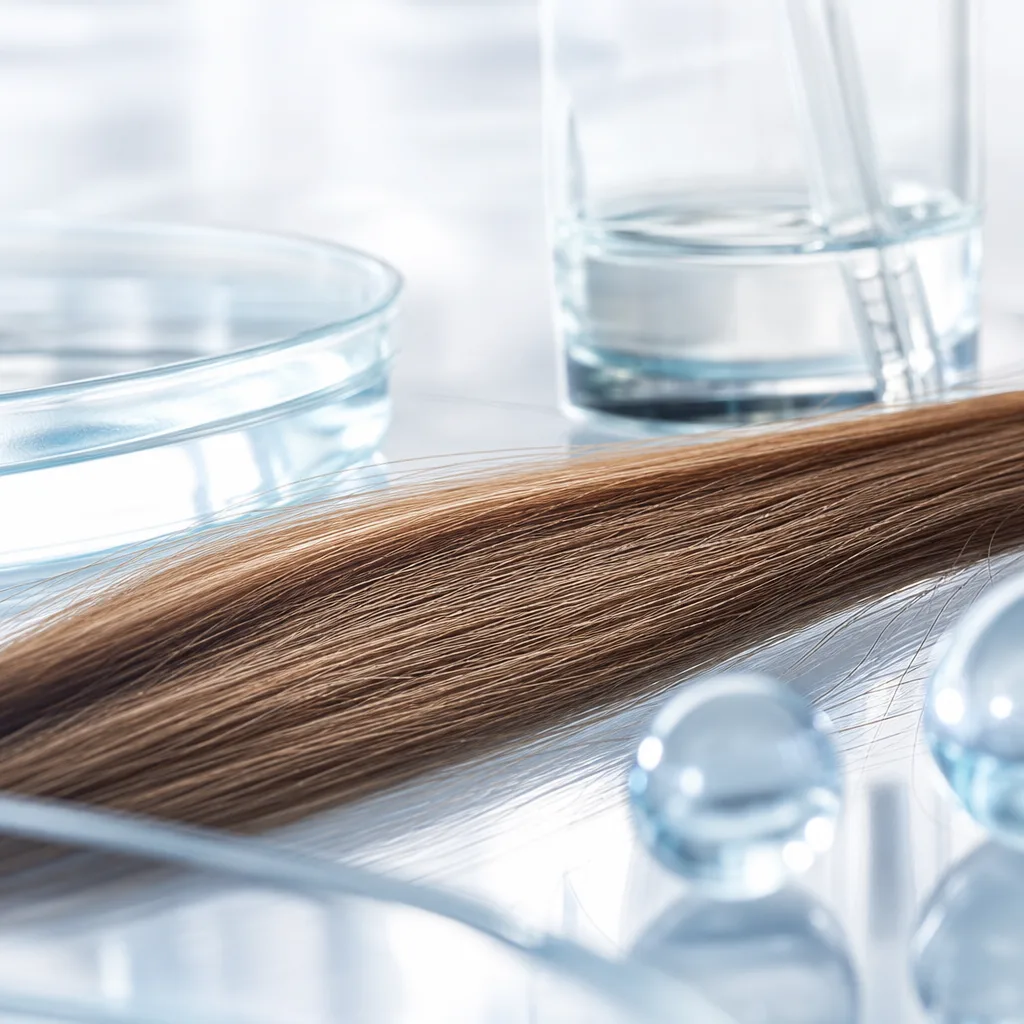
Hair consists largely of keratin, a structural protein that is in turn built from amino acids. Protein in general plays a particularly important role here, as do sulphur-containing amino acids such as cysteine, which are partly responsible for cross-linking and thus for the stability and elasticity of hair. A fundamental protein deficiency in the diet can therefore affect hair quality.
Hair growth itself is also an energy-intensive process. On very one-sided diets with a strong calorie deficit, the body prioritises vital functions over hair growth, which can show up a few months later as increased hair loss.
This time lag is an important point: a nutritional deficit a few months ago may only now show in the hair, while the actual cause may long since have been resolved. This makes it hard to link diet and hair condition correctly by intuition in daily life.
02
Cysteine and other sulphur-containing amino acids
Much as with nails, which consist of related structural proteins, a genuine nutrient deficiency often shows first in fast-growing tissue such as hair and nails, before it becomes noticeable elsewhere in the body. This makes hair an early, if unspecific, indicator of the general nutritional situation.
Cysteine supplies sulphur molecules that are involved in the structure of keratin. A pronounced lack of cysteine or of protein overall, for example with a very one-sided diet or certain illnesses, can show up in more brittle, thinner hair. However, this does not automatically mean that taking additional cysteine improves hair growth further when protein intake is already sufficient.
Seasonal fluctuations are also normal: many people subjectively notice somewhat more hair loss in autumn than in spring. Such seasonal patterns have been described in smaller studies and differ clearly from pathological, persistently increased hair loss, which should be checked by a doctor, even though the exact causes of this seasonal fluctuation have not yet been conclusively clarified.
Stress can also affect hair indirectly, for example through changes in the hormonal balance or through a less favourable diet in stressful phases. A holistic view of lifestyle is therefore often more revealing than the isolated question of a single missing nutrient.
Hair colour can also play a role: lighter hair types naturally contain less melanin and are sometimes described as more sensitive to mechanical strain, regardless of amino acid supply. Such structural differences cannot be compensated for by diet alone.
Methionine, another sulphur-containing amino acid, is also often used in hair products. The body can partly convert methionine into cysteine, but an additional effect beyond an already sufficient intake is likewise not clearly proven.
In many products advertised as hair vitamins, cysteine or methionine is only one of numerous components alongside various vitamins and minerals. How large the individual contribution of the amino acids to the advertised overall effect actually is can hardly be read out scientifically from such combination products.
 Matching productMultivitaminAmazon →
03
What about L-arginine for the hair roots?
Arginine is occasionally linked with better blood flow to the scalp and thus with better-supplied hair roots, via the mechanism already described as a building block of nitric oxide, see also L-arginine. Direct, robust studies showing a clear effect of additional arginine intake on hair growth or hair density in humans are, however, still rare.
04
Overview: amino acids and hair
| Amino acid | Role for hair | Evidence on supplementation |
|---|---|---|
| Cysteine | Building block of keratin | relevant in a proven deficiency, otherwise little evidence |
| Methionine | Precursor of cysteine | similar, evidence thin |
| L-arginine | possible influence on scalp blood flow | so far few robust human studies |
05
Nutrition as the basis for healthy hair
Alongside amino acids, other nutrients also play a role for hair, such as zinc, iron and biotin. A genuine deficiency in one of these substances can affect hair growth and hair structure, but can only be reliably established through a medical examination, for example a blood test.
Supplementing blindly, without a known deficiency, by contrast has no proven added benefit for healthy hair. A more sensible approach is an overall balanced, protein-rich diet with regular meals and a sufficient variety of foods.
External factors such as frequent heat styling, aggressive colouring or heavy mechanical strain from brushing and tight hairstyles can also damage hair structure, regardless of diet. Anyone who complains of brittle hair should therefore also take a critical look at their own care and styling routine before looking for the cause in diet alone.
06
What the research says
In the case of a proven protein or amino acid deficiency, a link with poorer hair quality is plausible and partly documented. For the assumption that additionally taking amino acids reliably speeds up or improves hair growth when protein supply is already sufficient, however, the evidence is weak, and the results of individual small studies cannot simply be generalised.
Corresponding advertising claims for hair products should be viewed critically. Dietary supplements are no substitute for a balanced diet.
07
When a medical check is worthwhile
In the case of persistent or sudden hair loss, patchy hair loss or clearly altered hair growth, a dermatological check makes sense in order to rule out causes such as hormonal changes, thyroid disease or nutrient deficiencies. Taking supplements on your own does not replace this check.
A dermatological examination can also distinguish between different forms of hair loss, such as hereditary, diffuse or inflammatory hair loss. This distinction is important because the appropriate treatment differs greatly, and a blanket supplement does not specifically address any of these forms.
To a certain extent it is also normal for hair growth to run in cycles, with a share of hairs falling out regularly to make room for new hair. A generally heightened awareness of hair loss, for example from paying attention to individual hairs in the drain, does not automatically lead to a relevant diagnosis, and a professional assessment remains more reliable here than self-observation.
08
Frequently asked questions
Will my hair grow faster if I take additional amino acids?
If protein intake is already sufficient, an additional, clearly proven effect on growth speed is not established.
Which amino acid is most important for hair?
Cysteine is considered particularly relevant because of its role in keratin, but what is decisive is the overall protein supply, not a single substance.
Can a poor diet cause hair loss?
A pronounced nutrient deficiency can impair hair quality and hair growth, but other causes are often present as well and should be checked by a doctor.
How long does it take for a better diet to show in the hair?
Because hair grows only slowly, changes usually become visible only after several months; short-term effects within a few days are unrealistic.
Explore
Read next
 Protein types at a glance: whey, casein, plant-based and moreAn overview of all common protein types from whey to collagen, with a comparison table and links to detailed guides.
 Amino Acids: The Building Blocks of ProteinStructure, classification and functions of amino acids at a glance, with a table of all 20 proteinogenic amino acids and links to all guide…
 Supplements for Sport and Fitness: A Factual OverviewAll supplement categories at a glance, with the evidence rated from good to thin, plus safety and buying tips.