
6 min read
Amino Acids for Muscle Building: What Actually Counts
Amino acids are seen as building blocks for muscle growth. Here you can find out how they actually work and when a supplement beyond normal food makes sense.

Muscles consist largely of protein, and protein in turn of amino acids. This simple chain often leads to the assumption that more amino acids automatically mean more muscle growth. It is not that simple: what matters is the interplay of training stimulus, total protein intake across the day and sufficient energy intake.
This article explains how amino acids actually work in muscle building, what role individual amino acids such as leucine play and when targeted supplementation can make sense.
01
Muscle protein synthesis: the central mechanism
Hardly any topic in fitness is as heavily shaped by marketing as amino acid products for muscle building, with eye-catching packaging and big promises. The market for amino acid products in strength sports is hard to navigate, with many similar-sounding products and different price segments.
Especially for beginners in strength training, a realistic look at the subject is worthwhile: in the first months, the biggest gains usually come from the training itself and a generally adequate diet, not from a particular dietary supplement. Another often overlooked factor is the quality of training itself: a sensibly structured, progressively increased training load is ultimately more decisive for muscle growth than the question of which product is taken alongside.
Muscle building is based on what is known as muscle protein synthesis, the process in which the body builds new muscle protein from amino acids. Strength training sets a growth stimulus, and sufficient available amino acids provide the building material for it. If either is missing, the effect fails to appear: training without enough protein achieves as little as plenty of protein without a training stimulus.
Muscle fibre composition and individual genetic factors also influence how quickly and how strongly someone responds to the same training and nutrition stimulus. This explains why two people following an identical approach can make progress at different speeds, without there necessarily being mistakes in diet or training.
The body is constantly alternating between building up and breaking down muscle protein, and training and nutrition shift this balance over time towards building up. A single training day or a single high-protein meal barely changes this balance in a noticeable way; what matters is consistency over weeks and months.
The recovery phase between training sessions is also part of this mechanism. The actual muscle building does not take place during the training itself, but in the hours and days afterwards, when the body has building materials and rest available.
Sufficient sleep plays an underestimated role here, as many regenerative processes in the body take place during sleep. Anyone who regularly sleeps too little may make slower progress despite optimal protein intake and consistent training, because the body lacks the necessary recovery time.
 Matching productL-LeucineAmazon →

02
How much protein makes sense for muscle building?
The protein source itself also plays a minor role in muscle building, as long as enough high-quality protein is consumed overall. Animal and plant protein sources can be combined well, see also Combining plant protein sources, to achieve as broad an amino acid profile as possible across the day.
In sports science, amounts of about 1.2 to 2.0 grams of protein per kilogram of body weight per day are often cited as a range for strength athletes, well above the general DGE (German Nutrition Society) reference value of about 0.8 grams for the general population. What matters is the total intake spread across the day, not the amount of amino acids at a single point in time, more on this in the guide Protein for muscle building.
Where you land within this range depends, among other things, on training volume, body weight and whether you are currently in a calorie surplus or a calorie deficit. In a deficit, the upper end of the range is more likely to be recommended, to preserve muscle mass better.
Training experience also influences how noticeable a higher protein intake is at all. For complete beginners, the training stimulus itself is usually the limiting factor, whereas experienced athletes already train close to their individual potential, where every detail, including nutrition, carries more weight.
Beginners in strength training often benefit clearly even from amounts at the lower end of this range, while advanced athletes with a lot of training experience tend to sit at the upper end of the recommendation to support further progress. There is therefore no blanket figure for everyone.
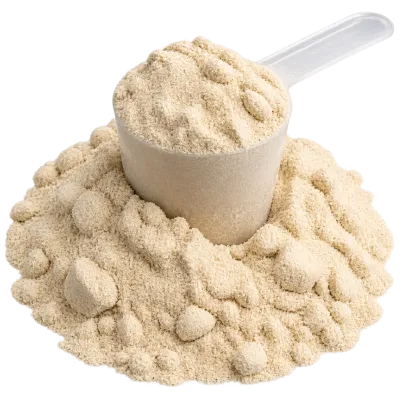 Matching productVegan Protein BlendAmazon →
03
The role of leucine and EAAs
Leucine is regarded as a particularly relevant trigger of muscle protein synthesis among the essential amino acids. For an effective stimulus, however, all the essential amino acids are needed together, known as EAAs, as the body can only build muscle protein when all the necessary building blocks are available at the same time. Isolated leucine without the other essential amino acids therefore does not automatically deliver a better effect than a complete protein.
 Matching productBCAA PowderAmazon →

04
Complete protein or isolated amino acids
| Form | Advantage | Limitation |
|---|---|---|
| Whole protein source (e.g. whey, legumes) | supplies all essential amino acids together | somewhat slower absorption than isolated amino acids |
| EAA / BCAA powder | quickly available, practical to dose | usually no added benefit when total protein intake is sufficient |
| Single amino acid (e.g. isolated leucine) | can trigger muscle protein synthesis in the short term | limited effect in the long run without the other amino acids |
 Matching productWhey IsolateAmazon →

05
Timing: how important is the exact time?
For a long time, a narrow window directly after training was seen as decisive. Today, sports science assumes that total protein intake spread across the day is considerably more important than the exact timing of individual portions. A regular distribution of protein across several meals is considered sensible, more on this in the article Protein timing.
In practice, this means that a meal one to two hours before or after training is sufficient in most cases, as long as enough protein is consumed across the whole day. The term anabolic window, often cited in the past, is now understood much more broadly than a few years ago.
An exception can apply to people who train fasted for many hours, for example straight after getting up without breakfast. Here a meal containing protein around the training session can make more sense, simply because otherwise no amino acids would be available for a long time, not because of a particularly narrow time window as such.
06
What the research says
The basic relationship between sufficient protein intake, strength training and muscle building is scientifically well established. For the targeted supplementation of isolated amino acids such as BCAAs on top of an already sufficient protein intake from normal food, however, the evidence is considerably weaker, and a clear added benefit beyond the pure protein effect cannot be reliably shown for most people.
Dietary supplements are no substitute for a balanced diet and no substitute for consistent training.
07
Practical perspective
If your daily protein intake from food or a complete protein powder is already in the recommended range, additionally taking isolated amino acids generally brings no decisive advantage for muscle building. Such a supplement can make more sense if you have little time for full meals on the go and need a quick, practical protein source.
If you have existing kidney disease or other pre-existing conditions, you should discuss a higher protein intake with a doctor beforehand.
Just as important as protein intake is a well-thought-out training plan with sufficient load, progressive increases and enough recovery between sessions. Without this stimulus, even the best amino acid supply remains ineffective, because the body only builds additional muscle tissue where there is an actual need for adaptation, regardless of how many additional products are taken alongside.
08
Frequently asked questions
Is normal protein powder enough for muscle building?
For most people, a complete protein powder already supplies all the essential amino acids needed for muscle protein synthesis.
Do BCAAs bring an advantage on top of enough protein?
When total protein intake is already sufficient, an additional, clearly proven benefit of BCAAs is not established.
How important is the timing of amino acid intake?
More important than exact timing is a sufficient total protein intake spread across the day, combined with regular strength training.
When does muscle growth become visibly noticeable?
For most people, the first visible changes appear after a few weeks of consistent training at the earliest; noticeable strength gains often occur earlier.
 Matching productVitamin C PowderAmazon →
Explore
Read next
 Protein types at a glance: whey, casein, plant-based and moreAn overview of all common protein types from whey to collagen, with a comparison table and links to detailed guides.
 Amino Acids: The Building Blocks of ProteinStructure, classification and functions of amino acids at a glance, with a table of all 20 proteinogenic amino acids and links to all guide…
 Supplements for Sport and Fitness: A Factual OverviewAll supplement categories at a glance, with the evidence rated from good to thin, plus safety and buying tips.